
Magnesium Alloy Die Casting for Lightweight Automotive Components


Magnesium Alloy Die Casting for Lightweight Automotive Components
Automotive lightweighting has become one of the core trends in modern vehicle manufacturing. Magnesium alloy die casting provides an ideal solution to reduce vehicle weight while maintaining structural performance. Magnesium alloys are the lightest structural metal widely used in automotive parts, helping automakers cut energy consumption and improve driving range for new energy vehicles.
Benefits of Magnesium Alloy for Automotive Die Casting
- Ultra-low density: Magnesium alloys are much lighter than aluminum and steel, greatly reducing component weight.
- High specific strength and stiffness, good shock absorption performance.
- Excellent dimensional stability and thin-wall casting capability.
- Good machinability, electromagnetic shielding and heat dissipation properties.
- Helps lower overall vehicle weight, reduce fuel consumption and extend EV battery range.
Common Automotive Components Using Magnesium Alloy Die Casting
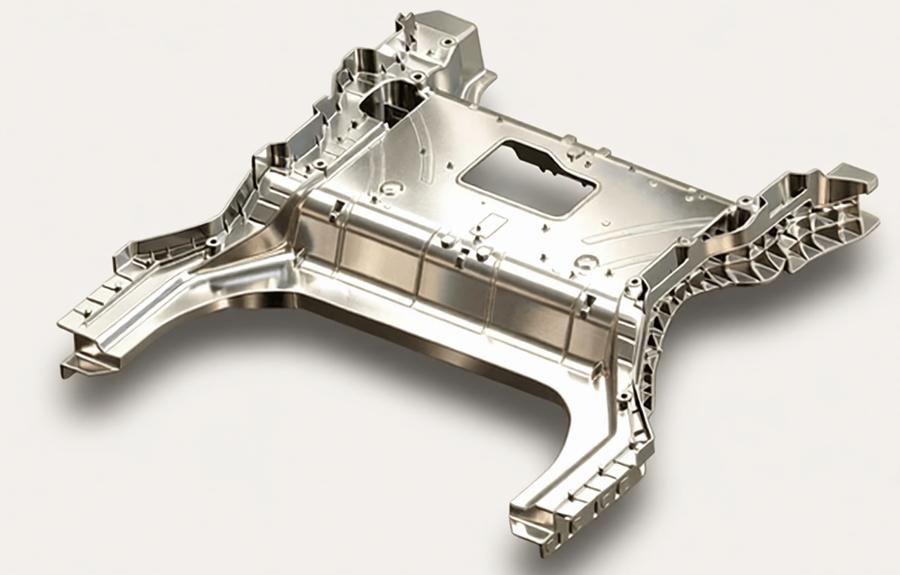
Magnesium die castings are widely applied in both traditional cars and new energy vehicles.
- Steering wheel frames and steering column housings
- Transmission and gearbox housings
- Instrument panel support beams
- EV motor end caps and battery housing accessories
- Seat frame structures
- Automotive bracket and housing parts
Magnesium Alloy Die Casting Process
- Mold design and fabrication: Custom mold built according to automotive drawing requirements, considering shrinkage, wall thickness and gating system.
- Melting: Magnesium alloy ingots are melted under protective atmosphere to prevent oxidation and burning.
- High-pressure die casting: Molten magnesium alloy is injected into steel mold cavity at high speed and pressure to form near-net-shape parts.
- Deburring and trimming: Remove overflow, flash and gates after casting.
- Post-treatment: CNC machining, surface finishing, heat treatment, coating or passivation as required.
- Quality inspection: Dimensional check, X-ray defect detection, mechanical property test before delivery.
Material Grades for Automotive Magnesium Die Casting
AZ91D is the most common magnesium alloy grade for automotive die casting. It balances good castability, mechanical strength and cost efficiency. AM60B and AM50A are also selected for parts requiring higher ductility and impact resistance.
Challenges of Magnesium Alloy Die Casting
Magnesium is active and easy to oxidize during melting and casting, so strict protection is required. The casting process needs precise temperature and pressure control. Mold maintenance is critical to avoid defects such as porosity, cold shut and oxidation in finished parts.
FAQ
Q: Why use magnesium alloy for automotive lightweight components? A: Magnesium alloy has the lowest density among common structural metals. It can reduce vehicle weight significantly to save energy and increase EV mileage while retaining enough structural strength.
Q: What surface treatments are available for magnesium die cast auto parts? A: Magnesium alloy parts can be processed with passivation, powder coating, painting, anodizing and plating for corrosion resistance.
Q: Can you provide custom magnesium alloy die casting service? A: Yes. Shenzhen Zhongzhu Technology offers custom magnesium alloy die casting, mold making, CNC machining and surface finishing for automotive and other industrial projects. We support samples and mass production.
Aluminum Die Cast VS Zinc Die Cast: Cost, Weight & Application Comparison




For more questions please
contact us

+86 755 28280203


315 PING 'AN AVENUE, PINGHU STREET, LONGGANG DISTRICT, SHENZHEN CITY, GUANGDONG PROVINCE