
Common Defects of Die Cast Components & Preventive Solutions

Die casting is the most efficient mass production process for complex aluminum, zinc and magnesium alloy housings used in telecommunications, automotive electronics and smart security devices. However, due to high-speed injection, rapid cooling, complex mold gating structure and unstable melting conditions, die cast parts are prone to various surface and internal defects during mass production. Uncontrolled defects will directly cause air leakage, poor assembly, surface coating failure, and high scrap rates for bulk orders.
Many overseas buyers encounter unstable quality problems when cooperating with ordinary foundries. Some suppliers only do simple visual inspection, ignoring internal porosity and hidden shrinkage defects, which lead to batch rejection after customers finish secondary CNC machining or anodizing. Based on years of mass production experience at Zhongzhu Technology, we summarize the eight most frequent die casting defects, analyze their root causes, and provide practical, factory-verified preventive solutions for your project quality control reference.
1. Porosity (Internal & Surface Air Holes)


Defect Performance: Tiny round holes on the surface or inside the casting, causing air leakage, poor air tightness, and bubbling after anodizing.
Root Causes: Excessive gas contained in molten alloy, insufficient mold venting, too fast injection speed, and damp raw material ingots.
Preventive Solutions:
-
Strict melting degassing treatment before production to reduce hydrogen content in liquid alloy
-
Optimize mold vent slots and overflow grooves to ensure smooth gas discharge during filling
-
Adjust multi-stage injection speed to avoid turbulent flow and air entrapment
-
Completely dry alloy raw materials to eliminate water vapor gas generation
2. Cold Shut / Flow Marks
Defect Performance: Obvious linear flow traces, uneven fusion lines on the part surface, affecting appearance and structural strength.
Root Causes: Low mold temperature, insufficient molten metal temperature, unreasonable runner layout, and slow filling speed.
Preventive Solutions:
-
Preheat the die-casting mold to stabilize mold temperature before mass production
-
Adjust furnace temperature according to alloy material to ensure good fluidity
-
Optimize gate position to shorten filling distance and reduce temperature loss
3. Flash / Burrs

Defect Performance: Extra thin metal edges on parting lines, pin holes and mold gaps, requiring heavy manual trimming.
Root Causes: Insufficient mold clamping force, mold surface wear, excessive injection pressure, and loose mold fitting clearance.
Preventive Solutions:
-
Regular mold maintenance and parting surface polishing to eliminate gap deformation
-
Match accurate clamping tonnage according to product projection area
-
Optimize injection pressure curve to avoid excessive pressure impact
4. Shrinkage Cavity & Shrinkage Depression
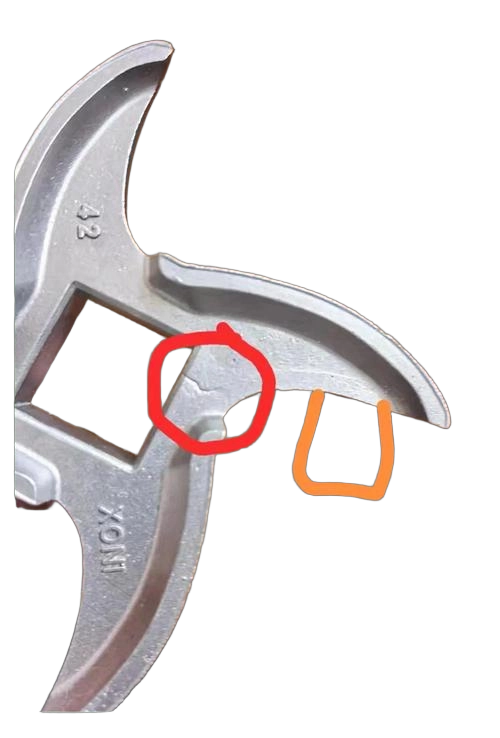
Defect Performance: Sinking dents or internal hollow cavities on thick wall positions, easily causing structural cracking under pressure.
Root Causes: Uneven wall thickness, insufficient feeding system, unreasonable cooling speed.
Preventive Solutions:
-
Optimize product structure during DFM stage to avoid sudden thick wall accumulation
-
Optimize riser and feeding channel to supplement molten metal during solidification
-
Adjust localized cooling water flow to balance solidification sequence
5. Deformation & Warpage
Defect Performance: Bending, twisting and flatness deviation after casting cooling, leading to assembly failure.
Root Causes: Unbalanced cooling distribution, unreasonable ejection pin layout, and residual internal stress.
Preventive Solutions:
-
Optimize mold cooling channel distribution for uniform temperature dissipation
-
Balance ejection force to avoid local forced deformation during demolding
-
Adopt targeted stress relief process for thin-wall and large-size flat parts
6. Oxide Inclusion & Slag Inclusion
Defect Performance: Black spots, hard particles and layered inclusions inside the parts, resulting in poor CNC finish and low product strength.
Root Causes: Unclean molten alloy surface oxidation slag, incomplete filtration, and turbulent pouring.
Preventive Solutions:
-
Skim and clean floating slag completely before casting
-
Install filter mesh in the runner system to block oxide impurities
-
Stable pouring speed to reduce secondary oxidation of molten metal
7. Insufficient Filling / Missing Material
Defect Performance: Incomplete edges, missing corners and unfilled thin-wall areas.
Root Causes: Low metal fluidity, insufficient injection volume, blocked vents, and ultra-thin wall structure.
Preventive Solutions:
-
Increase mold temperature and molten metal temperature appropriately
-
Optimize gate position for thin-wall areas to priority filling
-
Clean vent slots regularly to avoid gas blockage
8. Cracking & Tensile Fracture
Defect Performance: Micro-cracks or obvious fractures at sharp corners and thin-thick transition positions.
Root Causes: Sharp right-angle structure, excessive ejection force, and rapid cooling shrinkage stress.
Preventive Solutions:
-
Add rounded corners during DFM optimization to avoid stress concentration
-
Optimize ejection pin distribution for uniform force bearing
-
Control cooling rate to reduce shrinkage stress difference
Our Factory’s Standard Defect Prevention System

At Zhongzhu Technology, we do not rely on post-inspection to screen defective products. We implement full-process prevention to control defects from the source:
1. Pre-production DFM review eliminates structural risks that easily cause shrinkage, deformation and insufficient filling.
2. Fixed machine parameter locking prevents arbitrary parameter changes by workers during mass production.
3. 2-hour regular sampling inspection monitors surface quality and internal defects in real time.
4. Mold regular maintenance mechanism ensures stable venting, clamping and cooling performance of each mold.
Through systematic process control, our die casting batch scrap rate is kept below 1.2%, far lower than the industry average level.
Conclusion
Most die casting defects are not accidental; they are caused by unreasonable mold design, unstable process parameters and incomplete quality management. Only relying on post-inspection cannot solve fundamental quality problems. Source prevention, standardized process locking and systematic mold maintenance are the key to stable high-quality die casting mass production.
CTA
If you are troubled by die casting defects, unstable batch quality or high scrap rate, send your part drawings and defect problems to our engineering team. We provide professional DFM optimization, mold improvement suggestions and stable mass production solutions to ensure zero-defect delivery for your bulk orders.
Blog Tags
#DieCastingDefects #PorositySolution #DieCastQualityControl #AluminumDieCasting #ManufacturingOptimization #MassProductionQuality
Aluminum Die Cast VS Zinc Die Cast: Cost, Weight & Application Comparison


For more questions please
contact us

+86 755 28280203


315 PING 'AN AVENUE, PINGHU STREET, LONGGANG DISTRICT, SHENZHEN CITY, GUANGDONG PROVINCE