The Future of Semi-Solid Die-Casting in Manufacturing
Author: Samuel Song
2023-10-11
Compared with traditional die-casting, semi-solid rheological die-casting technology has the characteristics of low forming temperature, long mold life, smoother mold filling, denser structure, good product quality, and can improve production conditions.
It is currently widely used in automobiles, communications, and electrical appliances. , aerospace and medical fields. Semi-solid slurry preparation is a key link in the development of rheological die-casting technology.
Currently, semi-solid slurry preparation technologies such as stirring method, heat enthalpy method, serpentine runner method, and shear low-temperature casting method have been developed at home and abroad. However, although semi-solid forming technology has been applied so far, it needs further improvement and development both theoretically and technically.
With the development of computer technology, numerical simulation technology has been widely used in the study of semi-solid die-casting filling and solidification processes.
Through numerical simulation of the die-casting production process, defects that may occur during the solidification process can be more accurately predicted.
Through the application of computer numerical simulation technology in casting production, the quality of castings has been improved, the product development cycle has been shortened, and material costs have been saved.
For aluminum alloy 5G wireless router box lid castings, the Zhizhu Chaoyun CAE cloud platform was used to numerically simulate the die-casting filling process of the aluminum alloy box lid castings.
The process was optimized through simulation, and the mold was designed based on the process optimization results. and manufacturing.
And using Al-8Si aluminum alloy as raw material, the self-developed uniformly accelerated barrel incubation semi-solid rheological die-casting process was used to conduct production tests of router box lid castings.
Graphical results
Figure 1 shows the box cover of a certain type of 5G wireless router, which is made of Al-8Si aluminum alloy. The maximum outer dimension of the casting is 126mm×126mm×21mm.
The wall thickness is uneven, with the thin wall part being about 2mm and the thick wall part being about 7mm. The aluminum alloy density is 2.5g/cm3, the critical solid phase ratio is 67.5%, the liquidus temperature is 615°C, and the solidus temperature is 555°C.
It is produced using a die-casting process. The router box cover is a shell-like aluminum alloy die-casting. There are holes that need to be cast on three sides, that is, a three-sided core-pulling mechanism is required.
Therefore, the inner gate can only be set on the side without core-pulling, as shown in Figure 1. In the middle circle. A Toyo BD-250V5 die-casting machine is used.
The projected area of the die-casting part is 158cm2. One mold and two cavities are selected, and two process plans are designed, as shown in Figure 2.
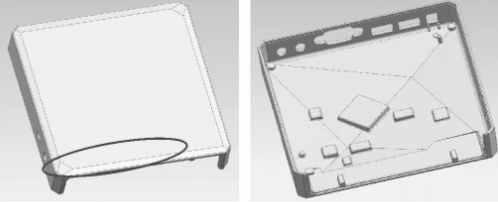
Figure 1 Three-dimensional view of the router box cover
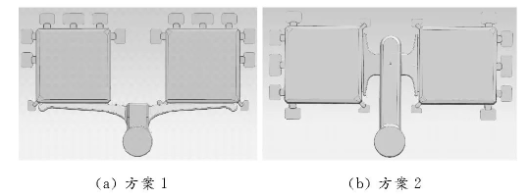
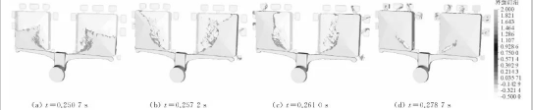
Figure 2 Die-casting process plan for box lid castings
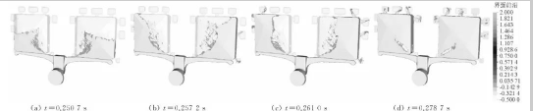
Figure 3 Simulation results of the die-casting filling process of Scheme 1
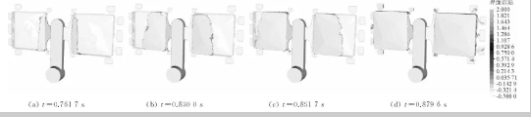
Figure 4 Simulation results of the die-casting filling process of Scheme 2
Plan 2 was used to design and manufacture the mold, and the self-developed uniformly accelerated barrel incubation semi-solid rheological die-casting process was used to conduct actual production tests of router box lid castings.
The exit temperature of the aluminum alloy liquid is 640°C. The injection punch adopts uniform acceleration injection during the low-speed injection stage.
The injection acceleration is about 0.86m/s2, the maximum low-speed speed is about 0.64m/s, and the high-speed speed is 2.0m/ s, the mold preheating temperature is about 200°C. Figure 5 shows the microstructure and physical picture of the semi-solid die-casting part of the router box cover.
It can be seen that the primary α-Al phase in the structure at all positions is mostly nearly spherical, with fine grains and even distribution, and has obvious semi-solid structure characteristics.
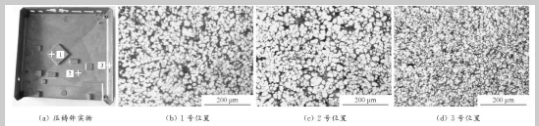
Figure 5 Microstructure and physical picture of semi-solid die-casting part of router box cover
Figure 6 X-ray flaw detection diagram of router box cover casting
in conclusion
The Zhizhu Chaoyun CAE cloud platform was used to conduct simulation analysis and optimization of the die-casting process plan for the router box cover.
Based on the simulation optimization results, a suitable process plan was determined and actual mold design, manufacturing and actual trial production were carried out.
The semi-solid rheological die-casting process was incubated by the self-developed uniformly accelerated barrel for actual production.
The produced die-casting parts were inspected by X-ray transmission and no defects such as shrinkage cavities, shrinkage porosity, pores and inclusions were found, and their thermal conductivity reached 165.3W/ (m·K), the quality meets the technical requirements.
Unlocking Excellence in CNC Machining: Addressing the Top 5 Concerns of European and American Clients
China has made high-end machine tools with an accuracy of 4μm, repeatable positioning of 2μm, and motion acceleration of 2G!
Related Article
Fast sampling is the fastest way to win business in the hardware machining and plastic mold industries. Customers want a working sample in days, and a 3D printer delivers it, but only when you know how to print in 3d correctly.
how to print in 3d
Fast sampling is the fastest way to win business in the hardware machining and plastic mold industries. Customers often send an STL file and expect a working sample in days.
how to print an stl file