
Analysis of the deceleration structure of the exhaust duct of aluminum alloy die-casting parts
Author: SZTC
2024-05-13
Aluminum alloy die-casting has the advantages of high dimensional accuracy, good appearance quality, and high production efficiency. However, because the molten metal fills the mold cavity in a high-speed jet state during die-casting, the gas cannot be discharged and is drawn into the molten metal. After solidification, it forms pores. The form remains within the casting. In order to eliminate the pores inside the die casting and improve the mechanical properties of the casting, vacuum die casting is usually used. The molten metal fills the mold cavity in a vacuum state. Since less gas is involved, it has a good effect on improving the internal quality of the casting, so it is widely used in the die-casting industry.
Mechanical vacuum valves are widely used in vacuum die-casting. They have the characteristics of large exhaust area, small gas flow resistance, and high vacuum degree. The working principle is to use the inertial impact force of the molten metal to close the valve core to complete a working cycle. . In the actual production process, the vacuum valve core may be clogged, causing malfunction and affecting the vacuuming effect. By improving the exhaust system of the oil cooler bracket and using Anycasting software for simulation, it was found that when the molten aluminum reaches the vacuum valve, the speed reaches 68m/s, which is extremely high and has a significant impact on the clogging of the vacuum valve. An effective way to solve the problem of vacuum valve clogging is urgently needed.
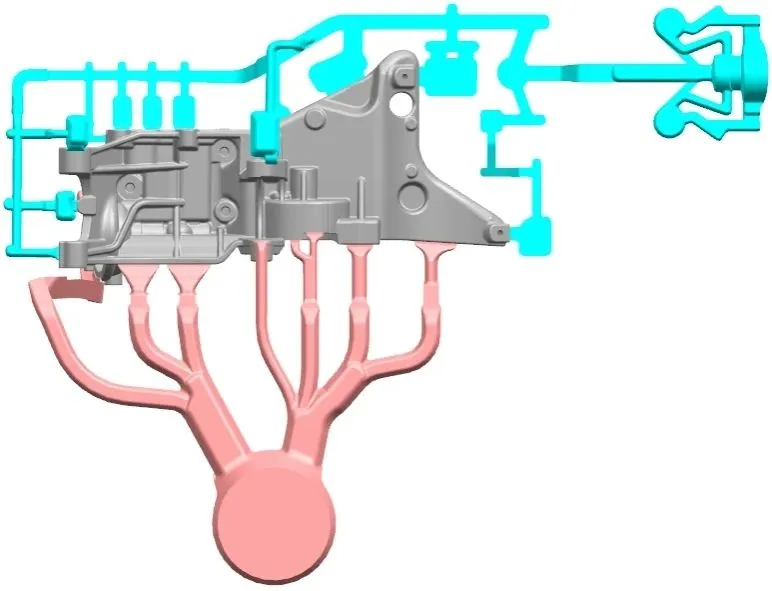
An oil cooler bracket, its structure and pouring and drainage system are shown in Figure 1. The overall dimensions are 411mm×214mm×191mm, the basic wall thickness is 4mm, the mass is 3.4kg, the gate cross-sectional area is 765m㎡, the exhaust cross-sectional area is 265m㎡, and the injection punch diameter is φ100mm. The schematic diagram of the vacuum valve core structure is shown in Figure 2. The head of the vacuum valve spool (Part A) is easily clogged; in addition, the tail part of the vacuum valve spool (Part B) is broken.
An oil cooler bracket, its structure and pouring and drainage system are shown in Figure 1. The overall dimensions are 411mm×214mm×191mm, the basic wall thickness is 4mm, the mass is 3.4kg, the gate cross-sectional area is 765m㎡, the exhaust cross-sectional area is 265m㎡, and the injection punch diameter is φ100mm. The schematic diagram of the vacuum valve core structure is shown in Figure 2. The head of the vacuum valve spool (Part A) is easily clogged; in addition, the tail part of the vacuum valve spool (Part B) is broken.
Due to the high-speed and high-pressure characteristics of the die-casting process, the head of the vacuum valve core is frequently washed away by high-speed and high-pressure aluminum liquid, causing the head of the vacuum valve core (see A in Figure 2) to become clogged; the tail of the vacuum valve core (see Figure 2) Point B in 2) is the weakest position. The molten aluminum liquid frequently impacts the valve core, which concentrates the force on the tail, causing the tail to easily break.
By adding a deceleration structure at the end of the exhaust duct, the impact speed of the aluminum liquid on the vacuum valve can be effectively weakened, the impact force on the vacuum valve can be reduced, and the problem of fracture of the tail of the vacuum valve core and the problem of vacuum valve clogging can be solved, thus improving the mechanical performance. The service life of the vacuum valve core.
By adding a deceleration structure at the end of the exhaust duct, the impact speed of the aluminum liquid on the vacuum valve can be effectively weakened, the impact force on the vacuum valve can be reduced, and the problem of fracture of the tail of the vacuum valve core and the problem of vacuum valve clogging can be solved, thus improving the mechanical performance. The service life of the vacuum valve core.
Current Application Status Of Titanium Alloys In The Automotive Industry
Microstructure and mechanical properties of semi-solid modified 6061 aluminum alloy rheological die-casting specimens
Related Article

Fast sampling is the fastest way to win business in the hardware machining and plastic mold industries. Customers want a working sample in days, and a 3D printer delivers it, but only when you know how to print in 3d correctly.
how to print in 3d

Fast sampling is the fastest way to win business in the hardware machining and plastic mold industries. Customers often send an STL file and expect a working sample in days.
how to print an stl file

