Research Status and Prospects of Low-pressure Casting Magnesium Alloys
Author: SZTC
2025-01-08
Introduction
Magnesium is the structural metal with the lowest density. It is rich in resources and has advantages such as high specific strength and specific stiffness, good vibration damping, strong electromagnetic shielding ability, easy cutting and easy recycling. It is widely used in the fields of automobiles, aerospace, electronic products, and national defense military products. Magnesium is an emerging structural metal material developed after steel and aluminum alloys. Its lattice structure is different from that of steel and aluminum. It is known as the green engineering material of the 21st century. Magnesium alloys have strong applicability in casting technology. Among several technologies for preparing magnesium alloy materials and components, casting magnesium alloys has the longest development history and the most mature technology and equipment. With the continuous development of high-tech, the demand for high-performance magnesium alloys is increasing, and the casting process is also improved and upgraded. At present, high-pressure casting is the most commonly used forming method for producing magnesium alloy parts, but die casting is only suitable for the production of large quantities of thin-walled parts. The investment cost of its equipment and molds is high, and it is easy to have casting defects such as air entrainment, which affects the quality of the finished product. Low-pressure casting is a casting method between high-pressure casting and gravity casting. It has stable filling and is more suitable for forming large and complex magnesium alloy castings. The castings can be heat-treated and strengthened, and the mechanical properties are further improved. Low-pressure casting magnesium alloys have shown good application prospects in recent years and have attracted more and more attention.
1 Characteristics and forming methods of low-pressure casting process
Low-pressure casting refers to a casting process in which the molten metal is filled from bottom to top under the action of low gas pressure and solidified under pressure to form castings. During the filling process of this process, the fluidity of the magnesium alloy liquid is improved, and it is easy to obtain castings with different wall thicknesses and complex structures. At the same time, during the filling process, its pressure is controllable, which can effectively alleviate the tumbling and splashing of the magnesium liquid during filling, so that the magnesium liquid fills the mold smoothly, reduces the formation of casting defects such as oxidation inclusions and looseness, and thus obtains high-quality castings. Common low-pressure casting methods include the most commonly used top-type gas pressure low-pressure casting, vacuum low-pressure lost foam casting, and electromagnetic low-pressure casting. The principle of the commonly used top-type gas pressure low-pressure casting technology is shown in Figure 1. The method is to pass 0.02~0.06 MPa of compressed gas into a sealed crucible, so that the molten metal slowly fills the cavity from bottom to top. After the filling is completed, the pressurization is stopped and the pressure is maintained until the casting is completely solidified, and then the pressure is released to allow the residual molten metal to flow back to the crucible, and finally the casting is demolded. In this process, the tumbling, impact and splashing of the molten metal are significantly reduced, thereby greatly reducing the generation of oxide slag; at the same time, its pressure filling method ensures the high fluidity of the alloy liquid and the density of the casting, which is suitable for the production of large and complex thin-walled castings. It is worth mentioning that due to the simple pouring and riser system designed in this process, the metal recovery rate can reach more than 90%, which greatly saves production costs. The process control of low-pressure casting has a great influence on the performance of the final casting. Taking low-pressure cast magnesium alloy wheel hub as an example, during the casting process, the order of filling the magnesium alloy liquid is usually wheel center-spoke-rim-rim, where the rim and rim are thin-walled areas far away from the gate, so the solidification order should be rim-rim-spoke-wheel center, which is sequential solidification. If the wheel hub does not achieve sequential solidification during the solidification process, solidification defects are likely to occur, such as thermal cracking defects at the spokes and rims, coarse grains at the wheel center, shrinkage cavities and shrinkage on the rim, etc. Therefore, in order to avoid the occurrence of casting defects as much as possible, it is necessary to adjust the mold temperature by means of local cooling, or adjust the pressure holding process to optimize the casting process. Vacuum low-pressure lost foam casting technology is a new casting process that integrates vacuum lost foam casting and low-pressure casting. Its schematic diagram is shown in Figure 2. The process steps are: first, put the lost foam casting pattern in the bottom-pouring sand box, add the molding sand and compact it, and start vacuuming; then add magnesium liquid into the pouring furnace, and at the same time, pass inert gas into the pouring furnace. The magnesium liquid flows into the sand box under pressure, and the high temperature brought by it can gasify the lost foam casting pattern and finally complete the pouring. This process has less equipment investment than the die-casting process, and the castings can be heat-treated and strengthened, and the casting cost performance is improved; the castings produced by sand casting have higher precision and better surface quality, and the production cycle is improved, and the final castings have higher comprehensive performance. The process requires a low pouring temperature, a small loss of pouring temperature, and a simple and effective pouring system for alloy castings with a high yield rate. It can be used for liquid forming of complex magnesium alloy components, and can obtain high-precision, low-surface-roughness and high-performance magnesium alloy castings, which improves the defects of insufficient pouring and cold shut that are easy to occur in castings in traditional casting processes. Zhang Dafu et al. applied this technology to the liquid precision forming of AZ91D magnesium alloy, and successfully prepared complex magnesium alloy castings such as motor housing and exhaust pipe, which effectively improved the defects of magnesium alloy such as insufficient pouring and cold shut, and greatly improved the performance of castings.
The conventional magnesium alloy low-pressure casting process mainly uses compressed air to fill the mold and maintain pressure to complete the production of castings. The electromagnetic low-pressure casting technology is a casting method that uses the Lorentz force to make the molten metal rise and fill the mold. Its schematic diagram is shown in Figure 3. It has high production efficiency, continuous and nearly zero-residue precision forming, and has unique advantages in the field of magnesium alloy low-pressure casting. In this process, an electric current is passed through the liquid metal, and the molten metal will move in a directional manner under the action of the Lorentz force. When a higher current and magnetic field strength are reached, the force generated can meet the requirements of conventional low-pressure casting. The molten metal is filled under computer control to ensure that the liquid level at different sections rises steadily. The liquid metal is filled into the mold, and after a certain solidification time, it is pressurized and maintained to finally obtain a high-quality casting. Studies have shown that the aluminum alloy wheels of motorcycles produced by electromagnetic pump low-pressure casting devices have obvious performance advantages over those produced by traditional low-pressure casting. However, compared with aluminum alloys, magnesium alloys have the characteristics of low specific heat and low latent heat of solidification, which leads to a fast cooling speed of magnesium alloy liquid in the mold cavity. Therefore, it is necessary to adjust the process parameters, such as rapid filling and strict control of mold temperature.
In addition, Wu Guohua and others innovatively developed a new process for precision low-pressure casting of large magnesium alloy castings by combining coating transfer core making technology, crucible liquid metal sealing technology and low-pressure casting technology, ensuring the high purity and high cleanliness of magnesium alloy liquid. The manufactured magnesium alloy castings have dense structure, high dimensional accuracy and good surface quality, and have the ability to develop and produce small batches of 100 kg magnesium alloy castings.
2 Development status of low-pressure casting of magnesium alloys
As early as the beginning of the 20th century, Britain proposed low-pressure casting technology and applied it to magnesium alloy production, but it was limited by the technology and equipment at that time and has not been widely used. After World War II, the automobile industry began to develop rapidly, and the demand for automobile wheels and other parts continued to increase. Such parts are also suitable for low-pressure casting production, and the technology has developed rapidly, but the equipment and technology are only in the hands of a few developed countries. After the mid-20th century, countries began to invest manpower and material resources to conduct in-depth research on the principles and processes of low-pressure casting technology. With the process of globalization and technological development, low-pressure casting equipment has been continuously upgraded, and its application range has become wider. It is now widely used in aerospace, automobile and various machinery industries.
Magnesium is the structural metal with the lowest density. It is rich in resources and has advantages such as high specific strength and specific stiffness, good vibration damping, strong electromagnetic shielding ability, easy cutting and easy recycling. It is widely used in the fields of automobiles, aerospace, electronic products, and national defense military products. Magnesium is an emerging structural metal material developed after steel and aluminum alloys. Its lattice structure is different from that of steel and aluminum. It is known as the green engineering material of the 21st century. Magnesium alloys have strong applicability in casting technology. Among several technologies for preparing magnesium alloy materials and components, casting magnesium alloys has the longest development history and the most mature technology and equipment. With the continuous development of high-tech, the demand for high-performance magnesium alloys is increasing, and the casting process is also improved and upgraded. At present, high-pressure casting is the most commonly used forming method for producing magnesium alloy parts, but die casting is only suitable for the production of large quantities of thin-walled parts. The investment cost of its equipment and molds is high, and it is easy to have casting defects such as air entrainment, which affects the quality of the finished product. Low-pressure casting is a casting method between high-pressure casting and gravity casting. It has stable filling and is more suitable for forming large and complex magnesium alloy castings. The castings can be heat-treated and strengthened, and the mechanical properties are further improved. Low-pressure casting magnesium alloys have shown good application prospects in recent years and have attracted more and more attention.
1 Characteristics and forming methods of low-pressure casting process
Low-pressure casting refers to a casting process in which the molten metal is filled from bottom to top under the action of low gas pressure and solidified under pressure to form castings. During the filling process of this process, the fluidity of the magnesium alloy liquid is improved, and it is easy to obtain castings with different wall thicknesses and complex structures. At the same time, during the filling process, its pressure is controllable, which can effectively alleviate the tumbling and splashing of the magnesium liquid during filling, so that the magnesium liquid fills the mold smoothly, reduces the formation of casting defects such as oxidation inclusions and looseness, and thus obtains high-quality castings. Common low-pressure casting methods include the most commonly used top-type gas pressure low-pressure casting, vacuum low-pressure lost foam casting, and electromagnetic low-pressure casting. The principle of the commonly used top-type gas pressure low-pressure casting technology is shown in Figure 1. The method is to pass 0.02~0.06 MPa of compressed gas into a sealed crucible, so that the molten metal slowly fills the cavity from bottom to top. After the filling is completed, the pressurization is stopped and the pressure is maintained until the casting is completely solidified, and then the pressure is released to allow the residual molten metal to flow back to the crucible, and finally the casting is demolded. In this process, the tumbling, impact and splashing of the molten metal are significantly reduced, thereby greatly reducing the generation of oxide slag; at the same time, its pressure filling method ensures the high fluidity of the alloy liquid and the density of the casting, which is suitable for the production of large and complex thin-walled castings. It is worth mentioning that due to the simple pouring and riser system designed in this process, the metal recovery rate can reach more than 90%, which greatly saves production costs. The process control of low-pressure casting has a great influence on the performance of the final casting. Taking low-pressure cast magnesium alloy wheel hub as an example, during the casting process, the order of filling the magnesium alloy liquid is usually wheel center-spoke-rim-rim, where the rim and rim are thin-walled areas far away from the gate, so the solidification order should be rim-rim-spoke-wheel center, which is sequential solidification. If the wheel hub does not achieve sequential solidification during the solidification process, solidification defects are likely to occur, such as thermal cracking defects at the spokes and rims, coarse grains at the wheel center, shrinkage cavities and shrinkage on the rim, etc. Therefore, in order to avoid the occurrence of casting defects as much as possible, it is necessary to adjust the mold temperature by means of local cooling, or adjust the pressure holding process to optimize the casting process. Vacuum low-pressure lost foam casting technology is a new casting process that integrates vacuum lost foam casting and low-pressure casting. Its schematic diagram is shown in Figure 2. The process steps are: first, put the lost foam casting pattern in the bottom-pouring sand box, add the molding sand and compact it, and start vacuuming; then add magnesium liquid into the pouring furnace, and at the same time, pass inert gas into the pouring furnace. The magnesium liquid flows into the sand box under pressure, and the high temperature brought by it can gasify the lost foam casting pattern and finally complete the pouring. This process has less equipment investment than the die-casting process, and the castings can be heat-treated and strengthened, and the casting cost performance is improved; the castings produced by sand casting have higher precision and better surface quality, and the production cycle is improved, and the final castings have higher comprehensive performance. The process requires a low pouring temperature, a small loss of pouring temperature, and a simple and effective pouring system for alloy castings with a high yield rate. It can be used for liquid forming of complex magnesium alloy components, and can obtain high-precision, low-surface-roughness and high-performance magnesium alloy castings, which improves the defects of insufficient pouring and cold shut that are easy to occur in castings in traditional casting processes. Zhang Dafu et al. applied this technology to the liquid precision forming of AZ91D magnesium alloy, and successfully prepared complex magnesium alloy castings such as motor housing and exhaust pipe, which effectively improved the defects of magnesium alloy such as insufficient pouring and cold shut, and greatly improved the performance of castings.
The conventional magnesium alloy low-pressure casting process mainly uses compressed air to fill the mold and maintain pressure to complete the production of castings. The electromagnetic low-pressure casting technology is a casting method that uses the Lorentz force to make the molten metal rise and fill the mold. Its schematic diagram is shown in Figure 3. It has high production efficiency, continuous and nearly zero-residue precision forming, and has unique advantages in the field of magnesium alloy low-pressure casting. In this process, an electric current is passed through the liquid metal, and the molten metal will move in a directional manner under the action of the Lorentz force. When a higher current and magnetic field strength are reached, the force generated can meet the requirements of conventional low-pressure casting. The molten metal is filled under computer control to ensure that the liquid level at different sections rises steadily. The liquid metal is filled into the mold, and after a certain solidification time, it is pressurized and maintained to finally obtain a high-quality casting. Studies have shown that the aluminum alloy wheels of motorcycles produced by electromagnetic pump low-pressure casting devices have obvious performance advantages over those produced by traditional low-pressure casting. However, compared with aluminum alloys, magnesium alloys have the characteristics of low specific heat and low latent heat of solidification, which leads to a fast cooling speed of magnesium alloy liquid in the mold cavity. Therefore, it is necessary to adjust the process parameters, such as rapid filling and strict control of mold temperature.
In addition, Wu Guohua and others innovatively developed a new process for precision low-pressure casting of large magnesium alloy castings by combining coating transfer core making technology, crucible liquid metal sealing technology and low-pressure casting technology, ensuring the high purity and high cleanliness of magnesium alloy liquid. The manufactured magnesium alloy castings have dense structure, high dimensional accuracy and good surface quality, and have the ability to develop and produce small batches of 100 kg magnesium alloy castings.
2 Development status of low-pressure casting of magnesium alloys
As early as the beginning of the 20th century, Britain proposed low-pressure casting technology and applied it to magnesium alloy production, but it was limited by the technology and equipment at that time and has not been widely used. After World War II, the automobile industry began to develop rapidly, and the demand for automobile wheels and other parts continued to increase. Such parts are also suitable for low-pressure casting production, and the technology has developed rapidly, but the equipment and technology are only in the hands of a few developed countries. After the mid-20th century, countries began to invest manpower and material resources to conduct in-depth research on the principles and processes of low-pressure casting technology. With the process of globalization and technological development, low-pressure casting equipment has been continuously upgraded, and its application range has become wider. It is now widely used in aerospace, automobile and various machinery industries.
Take low-pressure cast aluminum alloy wheels as an example. Its market share was only 4% in the 1980s, but by the beginning of the 21st century, its market share had expanded to more than 60%. At present, low-pressure casting has become the most important process for producing aluminum alloy wheels. In order to further accelerate the lightweighting process of automobiles, manufacturers and researchers in various countries are accelerating the research and development and production of magnesium alloy wheels to replace aluminum alloys to achieve deeper lightweighting. The research mainly focuses on new materials and new processes. Research shows that to obtain the same stiffness as aluminum alloy wheels, the wall thickness of magnesium alloy wheels only needs to be increased to 1.17 times that of aluminum alloy wheels, and its mass is only 78% of that of aluminum wheels, which has a significant lightweight effect; using magnesium alloy wheels instead of aluminum alloy wheels on new energy vehicles can increase vehicle endurance by more than 8%, and the acceleration performance and vibration reduction effect of the vehicle are also significantly improved. Currently, the casting processes used for magnesium alloys include gravity casting, high pressure casting, extrusion casting and low pressure casting. Among them, low pressure casting has unique advantages in the manufacture of magnesium alloy parts due to its characteristics such as stable filling and sequential solidification, and has received widespread attention in the industrial field. However, the production of magnesium alloy wheels through low pressure casting technology still needs to be further studied and improved, and the technology is not mature yet and has not been widely promoted and applied.
Since the 21st century, with the development of computer technology, numerical simulation technology has been widely used in the development and optimization of low pressure casting processes. By using software to numerically simulate the casting process of magnesium alloys, the location and causes of defects such as pores, looseness and slag inclusions in castings can be predicted in advance, shortening the product process development cycle, reducing the number of mold trials, and reducing production costs. Li Jingyi et al. used casting simulation software EasyCast and NovaCast to numerically simulate the low-pressure casting process of magnesium alloy partition castings. It was found that the solidification process of the partition castings did not follow the principle of sequential solidification and shrinkage cavities were generated. By adding cold iron to improve the process, the shrinkage compensation effect was effectively enhanced and the shrinkage cavity defects were improved. Zhang Hua et al. analyzed the casting process of AZ91D magnesium alloy wheels based on AnyCasting casting simulation software, accurately located the location of casting defects and found out the causes of defects, and then optimized the casting process, reducing the number of mold trials, thereby greatly reducing costs; the results of numerical simulation also provide theoretical guidance and basis for low-pressure casting of magnesium alloy wheels, and promote the process development and production process of low-pressure casting magnesium alloy wheels.
In recent years, the rapid development of new energy vehicles has put forward higher requirements for lightweighting in the automotive industry. Made in China 2025 proposes an overall plan for automobile development. Lightweighting has become one of the latest core development goals of automobile manufacturers around the world. Figure 4 shows the weight reduction effect of magnesium alloy on automobile parts. For every 10% reduction in the weight of pure electric vehicles, the cruising range can be increased by about 6%. The weight of the battery pack system of the vehicle accounts for more than 20% of the vehicle, and the cost accounts for 30% to 60% of the vehicle. In the power battery system, the battery shell accounts for about 2% to 30% of the total weight of the system and is the main structural component. Therefore, under the premise of ensuring the functional safety of the battery system and the overall safety of the vehicle, the lightweighting of the battery shell has become one of the main improvement goals of the battery system. The "Research Report on the Market Status of Aluminum-Magnesium Alloy Casting Industry" points out that magnesium alloy castings currently have three major conditions for replacing aluminum alloy castings in the field of lightweight automobiles, namely: the density of magnesium alloy is about 2/3 of that of aluminum alloy, and its specific strength is higher than that of aluminum alloy and steel. The use of magnesium alloy to replace aluminum alloy can achieve a weight reduction rate of 25% to 35%; the price ratio of magnesium to aluminum falls back to the 1.3 range, and "magnesium replacing aluminum" is more cost-effective economically; magnesium alloy has advantages in vibration resistance, heat dissipation, and strength. In 2022, the domestic use of magnesium alloy for a single vehicle will be only 3 to 5 kg, compared with the use of more than 100 kg for aluminum alloy single vehicles, and the development potential is huge. The full set of electric drive system housings for the Zhiji L7 model is the first mass production application of magnesium alloy materials on new energy electric drive housings. This is also one of the largest magnesium alloy components currently used in mass production in the automotive field at home and abroad. Subsequently, SAIC also developed a number of magnesium alloy new energy electric drive assembly products and successfully mass-produced them, which accelerated the expansion of new application scenarios for magnesium alloys and also heralded a bright application prospect for magnesium alloys in new energy vehicles. As the performance of new energy vehicles gradually improves, the requirements for lightweight and performance of components such as electric drive housings and battery trays have also increased, and the demand for low-pressure cast heat-treatable and strengthened magnesium alloy components has become more urgent.
3 Low-pressure cast magnesium alloy materials
Pure magnesium has poor strength, so pure magnesium is usually alloyed to obtain magnesium alloys. The alloying elements directly strengthen the mechanical properties of the alloy through precipitation hardening, fine grain strengthening and solid solution strengthening. Table 1 briefly introduces the most common alloying elements and their effects on magnesium alloys. Casting magnesium alloys can be mainly divided into Mg Al series, Mg-Zn series and Mg-RE series according to the main alloying elements. At present, the most widely used low-pressure cast magnesium alloy is Mg-Al-Zn (AZ) series.
3.1 Mg-Al series
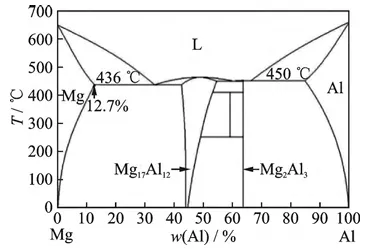
Mg⁃Al series is the earliest magnesium alloy material used, and Al is the most favorable element for improving the casting performance and mechanical properties of magnesium alloys. From the Mg-Al binary phase diagram (as shown in Figure 5), it can be seen that the solid solubility of Al in the α-Mg matrix changes significantly with temperature, and its limit solid solubility is 12.7% (mass fraction, 436 ℃), and the solid solubility at room temperature is about 2% (mass fraction). With the increase of Al content in magnesium alloy, the crystallization range of the alloy becomes narrower, the fluidity of the alloy is improved, the tendency of hot cracking is improved, the defects such as shrinkage are reduced, and the mechanical properties are also significantly improved. When the Al addition amount of the alloy exceeds 6% (mass fraction), it can also be heat-treated and strengthened. Adding alloying elements such as Zn and Mn on the basis of Mg-Al alloy (as shown in Table 2) can further improve the casting performance, mechanical properties, high temperature properties and corrosion resistance of magnesium alloy, and is widely used in industrial production.
The limit solid solubility of Zn in Mg-Al-Zn (AZ) alloy is 6% (mass fraction). Zn mainly plays a role in solid solution strengthening. After heat treatment, solid solution structure can be obtained to improve the yield strength and creep resistance of the alloy. However, when the mass fraction of Zn is too high, it is not good for the corrosion resistance of the alloy. Therefore, the Zn addition amount in magnesium alloy is generally controlled below 2% (mass fraction). Among many AZ alloys, AZ91D is the most widely used in low-pressure casting. This alloy has excellent formability and high mechanical properties, and can be applied to a variety of forming processes to manufacture complex structural parts. However, a low melting point brittle phase β-Mg17 Al12 will be formed in this series of alloys. With the increase of alloy load, microcracks are easily formed on the β-Mg17 Al12 phase and the β-Mg17 Al12 /α-Mg phase interface. These microcracks gradually connect to form main cracks until the alloy breaks and fails, as shown in Figure 6. In addition, the β-Mg17 Al12 phase is easy to soften and coarsen at high temperatures, resulting in low high temperature strength and poor high temperature creep performance. The enrichment on the grain boundary will reduce the creep resistance of the alloy, so that the alloy can only be used in working conditions below 125 ℃, which limits the development of this series of alloys. In recent years, in order to improve the comprehensive properties of the alloy, many researchers have tried to add microalloying elements to the AZ91 alloy, among which the addition of trace rare earth elements has the most significant effect on the improvement of alloy properties. Wang et al. studied the effect of adding different amounts of Gd on the properties of AZ91 cast alloy. The results showed that adding trace amounts of Gd can improve the strength and plasticity of AZ91 alloy, and the α-Mg grains and Mg17 Al12 phases are significantly refined because a dispersed spherical Al8 Mn4 Gd phase is formed in the alloy, which plays a second phase strengthening effect; in addition, this phase can serve as a heterogeneous nucleation point for α-Mg grains and Mg17 Al12 phases, and at the same time play a role in grain and microstructure refinement.
3 Low-pressure cast magnesium alloy materials
Pure magnesium has poor strength, so pure magnesium is usually alloyed to obtain magnesium alloys. The alloying elements directly strengthen the mechanical properties of the alloy through precipitation hardening, fine grain strengthening and solid solution strengthening. Table 1 briefly introduces the most common alloying elements and their effects on magnesium alloys. Casting magnesium alloys can be mainly divided into Mg Al series, Mg-Zn series and Mg-RE series according to the main alloying elements. At present, the most widely used low-pressure cast magnesium alloy is Mg-Al-Zn (AZ) series.
3.1 Mg-Al series
Mg⁃Al series is the earliest magnesium alloy material used, and Al is the most favorable element for improving the casting performance and mechanical properties of magnesium alloys. From the Mg-Al binary phase diagram (as shown in Figure 5), it can be seen that the solid solubility of Al in the α-Mg matrix changes significantly with temperature, and its limit solid solubility is 12.7% (mass fraction, 436 ℃), and the solid solubility at room temperature is about 2% (mass fraction). With the increase of Al content in magnesium alloy, the crystallization range of the alloy becomes narrower, the fluidity of the alloy is improved, the tendency of hot cracking is improved, the defects such as shrinkage are reduced, and the mechanical properties are also significantly improved. When the Al addition amount of the alloy exceeds 6% (mass fraction), it can also be heat-treated and strengthened. Adding alloying elements such as Zn and Mn on the basis of Mg-Al alloy (as shown in Table 2) can further improve the casting performance, mechanical properties, high temperature properties and corrosion resistance of magnesium alloy, and is widely used in industrial production.
The limit solid solubility of Zn in Mg-Al-Zn (AZ) alloy is 6% (mass fraction). Zn mainly plays a role in solid solution strengthening. After heat treatment, solid solution structure can be obtained to improve the yield strength and creep resistance of the alloy. However, when the mass fraction of Zn is too high, it is not good for the corrosion resistance of the alloy. Therefore, the Zn addition amount in magnesium alloy is generally controlled below 2% (mass fraction). Among many AZ alloys, AZ91D is the most widely used in low-pressure casting. This alloy has excellent formability and high mechanical properties, and can be applied to a variety of forming processes to manufacture complex structural parts. However, a low melting point brittle phase β-Mg17 Al12 will be formed in this series of alloys. With the increase of alloy load, microcracks are easily formed on the β-Mg17 Al12 phase and the β-Mg17 Al12 /α-Mg phase interface. These microcracks gradually connect to form main cracks until the alloy breaks and fails, as shown in Figure 6. In addition, the β-Mg17 Al12 phase is easy to soften and coarsen at high temperatures, resulting in low high temperature strength and poor high temperature creep performance. The enrichment on the grain boundary will reduce the creep resistance of the alloy, so that the alloy can only be used in working conditions below 125 ℃, which limits the development of this series of alloys. In recent years, in order to improve the comprehensive properties of the alloy, many researchers have tried to add microalloying elements to the AZ91 alloy, among which the addition of trace rare earth elements has the most significant effect on the improvement of alloy properties. Wang et al. studied the effect of adding different amounts of Gd on the properties of AZ91 cast alloy. The results showed that adding trace amounts of Gd can improve the strength and plasticity of AZ91 alloy, and the α-Mg grains and Mg17 Al12 phases are significantly refined because a dispersed spherical Al8 Mn4 Gd phase is formed in the alloy, which plays a second phase strengthening effect; in addition, this phase can serve as a heterogeneous nucleation point for α-Mg grains and Mg17 Al12 phases, and at the same time play a role in grain and microstructure refinement.
The effect is to improve the mechanical properties of the alloy. Boby et al. added Sn and Y to the AZ91 alloy and found that the addition of Sn formed a new Mg2 Sn phase, which inhibited the nucleation and growth of the discontinuous phase Mg17 Al12; when Y and Sn were added at the same time, a new Al2 Y phase appeared, The volume fraction of Mg17 Al12 decreases, the grain size is refined, and the room temperature and high temperature tensile properties and corrosion resistance of the alloy are improved. The optimal addition amounts of Sn and Y are 0.5% and 0.9% (mass fraction) respectively. Cai et al. found that adding Ce, Y and Gd can refine the Mg17 Al12 grain size, optimize its distribution, reduce the content of the Mg17 Al12 phase in the alloy, thereby improving the alloy's mechanical properties and corrosion resistance, among which Ce has the most significant effect. Followed by Y and Gd. Up to now, adding micro-alloying elements such as Ce, Nd, Y, Ca, Ti, B, Sr, Sb and Bi to AZ91 magnesium alloy has been widely studied. Among them, Ce, Nd have the best effect on improving mechanical properties. , Y, Bi and Sb.
The ultimate solid solubility of Mn in Mg-Al-Mn (AM) series alloy is 3.4% (mass fraction). The strength of this series alloy is lower than that of AZ series alloy, but it has excellent toughness and plasticity and is suitable for applications that need to withstand impact loads and requirements. In places with high safety, such as seat frames, equipment dashboards and automobile wheels, AM50 and AM60 alloys are the most widely used in low-pressure casting. Japan, Italy, the United States and other countries use AM60A and AM60B to manufacture die-cast magnesium alloy wheels with excellent performance; China has also produced AB60B automobile wheel castings through metal gravity casting, with a process yield rate as high as 65%, which provides a new opportunity for low-pressure casting to produce magnesium alloys. Hub has accumulated experience.
The ultimate solid solubility of Mn in Mg-Al-Mn (AM) series alloy is 3.4% (mass fraction). The strength of this series alloy is lower than that of AZ series alloy, but it has excellent toughness and plasticity and is suitable for applications that need to withstand impact loads and requirements. In places with high safety, such as seat frames, equipment dashboards and automobile wheels, AM50 and AM60 alloys are the most widely used in low-pressure casting. Japan, Italy, the United States and other countries use AM60A and AM60B to manufacture die-cast magnesium alloy wheels with excellent performance; China has also produced AB60B automobile wheel castings through metal gravity casting, with a process yield rate as high as 65%, which provides a new opportunity for low-pressure casting to produce magnesium alloys. Hub has accumulated experience.
In addition to the above AZ series and AM series magnesium alloys, directly adding alloying elements such as Ce, Nd, Y, Sb, Bi, Ca, Ti, B and Sr to Mg-Al series alloys can achieve grain refinement and Melt purification, solid solution strengthening and second phase strengthening effects. Adding 2%~4% (mass fraction) Ce element to Mg-4Al alloy can form Al11 Ce3 and reduce the formation of Mg17 Al12. The AE44 alloy obtained by optimized design is suitable for high temperature working conditions, such as Corvette engine frame, whose operating temperature is as high as to 150 ℃. However, approximately 16% (mass fraction) of Ce is required to completely suppress the formation of the Mg17Al12 phase in the Mg-4Al alloy, which is too costly for most automotive applications, so Mg-Al-Ca alloys (AX series) are Designed as a lower cost alternative to AE series alloys. Luo et al.’s simulation results of the Mg-Al-Ca solidification path show that as the Ca content increases, the Mg17 Al12 phase fraction decreases, while the (Mg, Al) 2 Ca phase fraction increases; when the mass fraction of Ca reaches 3% (AX53 alloy), the Mg17 Al12 phase is completely suppressed by the binary Mg2 Ca and ternary (Mg, Al) 2 Ca phases. The room temperature yield strength, 175 ℃ yield strength and creep resistance of the cast alloy are 186, 151 and 74 respectively. MPa, far exceed the performance of AM50 cast alloy, and have good application prospects in automotive parts.
3.2 Mg-Zn series
In Mg-Zn cast magnesium alloys, Zn mainly plays the role of solid solution strengthening and age strengthening, and the alloy can be strengthened by heat treatment; in addition, Zn can also well avoid the corrosion performance caused by impurity elements such as iron and nickel in magnesium alloys. deterioration. Mg-Zn-Al (ZA) cast magnesium alloy has good casting performance and excellent creep resistance, and its mechanical properties even exceed those of traditional AZ and AM systems. Cast magnesium alloy ZA-based alloy has good age hardening response, and its aging precipitation sequence is: SSSS (supersaturated solid solution) → GP zone → β1 ʹ (Mg4 Zn7) → β2 ʹ (MgZn2) → β (MgZn or Mg2 Zn3). Taking ZA64 alloy as an example, after solution and aging treatment, its tensile strength increased from 183 MPa in the cast state to 260 MPa, and the elongation increased by more than 1 times. Further adding alloying elements, such as Cu, Sn, Sr, Ca, Sb and RE, etc., to Mg-Zn cast magnesium alloys is the most commonly used method to improve the mechanical properties of ZA series alloys. However, ZA series magnesium alloys have a high Zn content, and the alloy is prone to severe hot cracking and has poor casting performance, which limits its industrial application. This series of alloys is still in the research stage and awaits further commercial application.
3.3 Mg-RE series
Mg-RE series (magnesium-rare earth series) cast magnesium alloys are currently an important direction in the development of high-performance magnesium alloys. Rare earth (RE) elements have a certain degree of purification effect on magnesium alloy melts, and can also improve casting performance, optimize structure, Improve the mechanical properties and creep resistance of the alloy; adding RE elements can increase the strength of magnesium alloys by 100% to 250%, increase the ultimate operating temperature to 350°C, significantly improve the corrosion resistance, and expand the application fields of magnesium alloy materials. As the solid solubility of rare earth elements in magnesium alloys increases, its strengthening effect will become more obvious. Figure 7 shows the difference in performance and density of Mg-RE, Mg-Al, and Mg-Zn casting alloys. At present, Mg-Y, Mg-Nd, and Mg-Gd series alloys have strong age hardening effects and great potential for practical application. They have become the most widely researched and applied Mg-RE series cast magnesium alloys.
The solid solubility of Y element in α-Mg is high, so the alloy has strong aging strengthening ability. Its aging precipitation sequence is: SSSS (supersaturated solid solution) → βʹʹ (DO19-Mg3 Y) → βʹ (cbco-Mg7 Y) → β1 (fcc-Mg3 Y) → β (fcc-Mg5 Y). A large number of studies have shown that the peak age strengthening effect of Mg-Y alloys mainly comes from the dispersed and precipitated nanoscale metastable βʹ phase. The orientation relationship between this phase and the α-Mg matrix is: (100) βʹ // (1-210) Mg, [001]βʹ //[0001]Mg, its three-dimensional structure is shown in Figure 8. In order to further improve the alloy strength and creep resistance, researchers added other rare earth elements to the Mg-Y alloy binary alloy to form an Mg-Y-RE ternary alloy system. Among them, WE43 is one of the most typical magnesium rare earth cast magnesium alloys. After appropriate solid solution and aging treatment, the strength of the metal mold cast alloy is greatly improved, the tensile strength can reach 345 MPa, and it can still be used at 300 ℃. Maintain good mechanical properties; adding trace amounts of Zn to WE43 alloy can promote the precipitation of dispersed fine precipitates and produce long period ordered structure (LPSO) phases, thus improving the age hardening response speed and mechanical properties of the alloy, especially The elongation is significantly improved.
Zn, Y, Nd and other alloying elements are added to the Mg-Gd cast magnesium alloy to form a ternary or multi-component alloy, which has higher mechanical properties and the tensile strength can even exceed 350 MPa. When the Zn element is added to the Mg-Gd system, the aging precipitation sequence of the alloy will change. When the mass fraction of Gd in the alloy is less than 6%, the precipitation sequence is: SSSS → γʹʹ (hcp-Mg70 Gd15 Zn15 ) → γʹ (hcp -MgGdZn) → γ(hcp Mg12 GdZn). The γʹ phase is formed on the α-Mg basal surface, which can increase the peak aging hardness of the alloy. When Zn is added to an alloy with a high Gd content, the precipitation strengthening comes from the composite effect of the βʹ phase precipitated on the matrix prism surface and the γʹ phase precipitated on the basal surface, and the mechanical properties of the alloy are further improved. After Rong et al. added 1% Zn (mass fraction) to the Mg-15Gd-0.4Zr alloy, the yield strength of the peak-aged alloy increased from 232 MPa to 288 MPa, and the tensile strength increased from 296 MPa to 403 MPa. This is because The γʹ and βʹ phases are relatively vertically distributed in the matrix, producing a composite strengthening effect on the matrix. The microstructure morphology is shown in Figure 9. In addition, Shanghai Jiao Tong University developed a high-strength and heat-resistant casting Mg-10Gd-3Y-0.5Zr (GW103K, JDM2) alloy based on Mg-Gd alloy, which has better fluidity and resistance to hot cracking during low-pressure casting or gravity casting. After solid solution and aging treatment, the mechanical properties of the alloy at room temperature are greatly improved, with a yield strength as high as 240 MPa and an elongation of 6%. The yield strength can still maintain a high level at a high temperature of 300°C, which is very important for aerospace, military industry, etc. It has made great contributions to lightweighting in the field and has been used in the preparation of lightweight missile casings and radar components.
Zn, Y, Nd and other alloying elements are added to the Mg-Gd cast magnesium alloy to form a ternary or multi-component alloy, which has higher mechanical properties and the tensile strength can even exceed 350 MPa. When the Zn element is added to the Mg-Gd system, the aging precipitation sequence of the alloy will change. When the mass fraction of Gd in the alloy is less than 6%, the precipitation sequence is: SSSS → γʹʹ (hcp-Mg70 Gd15 Zn15 ) → γʹ (hcp -MgGdZn) → γ(hcp Mg12 GdZn). The γʹ phase is formed on the α-Mg basal surface, which can increase the peak aging hardness of the alloy. When Zn is added to an alloy with a high Gd content, the precipitation strengthening comes from the composite effect of the βʹ phase precipitated on the matrix prism surface and the γʹ phase precipitated on the basal surface, and the mechanical properties of the alloy are further improved. After Rong et al. added 1% Zn (mass fraction) to the Mg-15Gd-0.4Zr alloy, the yield strength of the peak-aged alloy increased from 232 MPa to 288 MPa, and the tensile strength increased from 296 MPa to 403 MPa. This is because The γʹ and βʹ phases are relatively vertically distributed in the matrix, producing a composite strengthening effect on the matrix. The microstructure morphology is shown in Figure 9. In addition, Shanghai Jiao Tong University developed a high-strength and heat-resistant casting Mg-10Gd-3Y-0.5Zr (GW103K, JDM2) alloy based on Mg-Gd alloy, which has better fluidity and resistance to hot cracking during low-pressure casting or gravity casting. After solid solution and aging treatment, the mechanical properties of the alloy at room temperature are greatly improved, with a yield strength as high as 240 MPa and an elongation of 6%. The yield strength can still maintain a high level at a high temperature of 300°C, which is very important for aerospace, military industry, etc. It has made great contributions to lightweighting in the field and has been used in the preparation of lightweight missile casings and radar components.
The ultimate solid solubility of the Gd element in α-Mg is higher than that of Y. When the temperature is cooled from 548 ℃ to 200 ℃, its solid solubility drops from 23.5% to 4% (mass fraction), so the Mg-Gd alloy needs to be aged. , the matrix can precipitate a large number of nanophases, bringing significant age hardening effect. The aging precipitation sequence of Mg-Gd is exactly the same as that of the Mg-Y series. In the peak aging state, βʹ and βʹʹ or βʹ and β1 phases coexist. The alloy has strong room temperature yield strength.
The ultimate solid solubility of the light rare earth element Nd in α-Mg is about 3.6% (mass fraction), which can also produce a strong precipitation strengthening effect on magnesium alloys. The aging precipitation sequence of Mg-Nd series alloy is: SSSS → βʹʹ (DO19-Mg3 Nd) → βʹ (fcc-Mg3 Nd) → β (bct Mg12 Nd). βʹʹ is the main strengthening phase in the peak aging state of the alloy. This phase It is completely consistent with the magnesium matrix, and the orientation relationship between the two is: (0001) βʹʹ // (0001) Mg, βʹʹ //Mg. The βʹʹ phase has high thermal stability and can improve the high-temperature stability and heat resistance of Mg-Nd alloy. However, the growth limiting factor Q value of Nd element in Mg is small and does not have an obvious refining effect on magnesium alloys. Therefore, the cast grains of Mg-Nd alloys are usually coarse and cannot be used as structural materials. Usually Additional elements such as Zr or Zn need to be added to refine the grains and improve casting performance. Shanghai Jiao Tong University adjusted the Nd/Zn ratio on the basis of high-strength and heat-resistant ZM6 alloy and developed Mg-3Nd-0.2Zn-0.4Zr (JDM1) magnesium rare earth alloy with excellent performance and low cost. This alloy has good casting properties. Performance and mechanical properties, it has been applied to automobile wheels, engine brackets and other parts.
The above-mentioned common types of cast magnesium alloy series and their performance characteristics are summarized in Table 3 and Table 4. In actual production, it is necessary to select the appropriate alloy material according to the usage conditions of the casting. The existing alloy series have some performance and application bottlenecks. Therefore, optimizing alloy compositions and developing new alloys has become one of the important research directions for cast magnesium alloys.
4 Strengthening mechanism of low-pressure casting magnesium alloy
Although the density of magnesium alloys is low, the mechanical properties of currently commonly used magnesium alloy materials are still far behind those of steel and aluminum. Therefore, in order to improve the comprehensive performance of cast magnesium alloys, researchers mainly focus on magnesium alloy composition design and optimization, microstructure control, process optimization, heat treatment optimization, etc. to determine the strengthening and toughening mechanism of magnesium alloys and develop new high-performance cast magnesium alloys. . Magnesium alloys have a close-packed hexagonal structure, and the deformation mechanisms are mainly dislocation slip and twinning. The grain size, solid solution atoms, and the second phase will all affect the mechanical properties of cast magnesium alloys.
4 Strengthening mechanism of low-pressure casting magnesium alloy
Although the density of magnesium alloys is low, the mechanical properties of currently commonly used magnesium alloy materials are still far behind those of steel and aluminum. Therefore, in order to improve the comprehensive performance of cast magnesium alloys, researchers mainly focus on magnesium alloy composition design and optimization, microstructure control, process optimization, heat treatment optimization, etc. to determine the strengthening and toughening mechanism of magnesium alloys and develop new high-performance cast magnesium alloys. . Magnesium alloys have a close-packed hexagonal structure, and the deformation mechanisms are mainly dislocation slip and twinning. The grain size, solid solution atoms, and the second phase will all affect the mechanical properties of cast magnesium alloys.
4.1 Fine grain strengthening
Fine-grain strengthening refers to improving the strength of the metal through the refinement of the grain size in polycrystalline alloys. The Hall-Petch formula can be used to describe the contribution of fine-grain strengthening to strength σgb: σgb = σ0 + kD−1/2 ( 1) In the formula, σ0 is the yield strength of the initial grain structure of pure metal, ki is the Hall-Petch constant, and D is the average diameter of the grains. The k value of magnesium alloy is very large, 280~320 MPa·μm1/2, which is more than 4 times that of aluminum alloy. Therefore, grain refinement is more effective in improving the mechanical properties of magnesium alloy. In addition, the fine-grain structure is more uniform, and stress concentration cracking is less likely to occur during deformation, which improves the plasticity and toughness of the alloy. During the liquid forming process, the fine-grained structure can also significantly improve the fluidity of the melt and improve the quality of the alloy ingot. For low-pressure casting magnesium alloys, due to the slow mold filling speed and low melt solidification speed of this process, the resulting alloy grain structure is often coarser and has lower mechanical properties. Therefore, the grain structure of low-pressure casting magnesium alloys is studied. It is particularly important to refine methods and principles.
Currently available as-cast grain refinement technologies for magnesium alloys can be divided into two methods, which are to achieve grain refinement through melt treatment (such as inoculation, alloying) or stirring (such as ultrasonic treatment) during the casting process. The role of solute elements in grain refinement has been widely discussed, and researchers generally believe that component supercooling caused by solute segregation is the main cause of grain refinement. Supercooling of components can inhibit the continued growth of original grains by promoting the nucleation of new grains, thus achieving a tissue refinement effect. Adding some solute elements to magnesium alloys can effectively inhibit grain growth. This effect can be quantitatively described by the growth restriction factor Q (Growth Restriction Factor, GRF). In a binary alloy system, its expression is as follows:
In the formula, m is the slope of the liquidus line, C0 is the solute concentration in the alloy, and ki is the distribution coefficient of the solute element. The size and shape of grains in binary magnesium alloys are directly related to the type and content of solutes present in the alloy: the larger the Q value, the greater the tendency of the solute to form a supercooled zone at the dendrite/liquid front, resulting in finer grains. The effect is more significant. In binary system cast magnesium alloys, the Q values of common solute elements are shown in Table 5. It should be noted that the Q values listed in the table are only for binary systems, but in actual alloys they are often ternary or even multi-component systems, which are not applicable to this equation, but still have reference significance.
It can be seen that adding solute elements with higher Q values such as Zr, Ca and Si can effectively refine magnesium alloy grains. Although Fe element has the highest Q value, it has a negative impact on the corrosion resistance of magnesium alloys. Therefore, Fe is generally not considered as an alloying element of magnesium alloys. The Q value of Zr element is second only to Fe, and its crystal structure is hexagonal close-packed
In the formula, m is the slope of the liquidus line, C0 is the solute concentration in the alloy, and ki is the distribution coefficient of the solute element. The size and shape of grains in binary magnesium alloys are directly related to the type and content of solutes present in the alloy: the larger the Q value, the greater the tendency of the solute to form a supercooled zone at the dendrite/liquid front, resulting in finer grains. The effect is more significant. In binary system cast magnesium alloys, the Q values of common solute elements are shown in Table 5. It should be noted that the Q values listed in the table are only for binary systems, but in actual alloys they are often ternary or even multi-component systems, which are not applicable to this equation, but still have reference significance.
It can be seen that adding solute elements with higher Q values such as Zr, Ca and Si can effectively refine magnesium alloy grains. Although Fe element has the highest Q value, it has a negative impact on the corrosion resistance of magnesium alloys. Therefore, Fe is generally not considered as an alloying element of magnesium alloys. The Q value of Zr element is second only to Fe, and its crystal structure is hexagonal close-packed
Crystal lattice, adding Zr to magnesium alloys that do not contain Al and Mn (such as Mg-RE, Mg Zn-RE, etc.) can significantly refine the grains; while Zr and elements such as Al, Mn, Si, and Fe are easily The reaction occurs to form stable intermetallic compounds. These compounds are usually formed in the late stage of solidification and cannot serve as nucleation cores to refine the structure; the additional consumption of Zr leads to a further reduction in its refinement effect. The dual effect limits Zr in magnesium-containing materials such as Al and Mn. Applications in Alloys. The Q value of the Ca element is also high, and Ca and Al will react in situ to generate Al2Ca, which has a high lattice match with Mg and can become an effective heterogeneous nucleation core for the magnesium matrix. In Mg-Al alloys It has great application potential as a grain refiner and has been widely studied in recent years. In addition to the elements listed in Table 5, Wang et al. added 0.01% Ti (mass fraction) to AZ31 magnesium alloy, the grain size was significantly reduced; the Q value of Ti was calculated to be 59500, which is higher than that in the Mg-Zr system. The growth limiting factor is 4 orders of magnitude higher, indicating that the extremely high compositional supercooling ability of Ti as a solute element leads to efficient grain refinement of the AZ31 alloy.
There are also some elements that will react with other solute elements in the magnesium alloy melt to form stable intermetallic compounds. Some of these particles can serve as nucleation cores during the solidification process, while others will gather at grain boundaries to hinder grain growth. Finally, the grain refinement effect is achieved, such as adding Mn and RE elements. Mn is one of the few elements that can undergo a peritectic reaction with Mg. Therefore, although Mn has a very low Q value, it is still widely studied as a refinement element for magnesium alloys. However, Mn is usually removed after the melt is overheated. In order to have a refining effect, adding a small amount of Mn to the AZ91 alloy can significantly refine the grains after the overheating reaction. Adding some rare earth elements to cast magnesium alloys can often have a significant grain refinement effect. After Wang et al. added La, Pr and Ce to the Mg-Al system, the ingot grains were significantly refined, which was mainly attributed to the restriction of grain growth by RE element segregation at the frontier of the solid-liquid interface. This hypothesis is based on the RE-containing intermetallic compounds observed at grain boundaries in cast magnesium alloys. Chia et al. also support this view. They added La, Ce and Nd to Mg and obtained similar grain refinement results.
In addition to adding alloying elements, adding solid particles as grain refiners or in-situ generated particles to the low-pressure casting magnesium alloy melt can increase the number of nucleated grains during the solidification process to achieve the effect of grain refinement. . For Mg-Al alloys, adding C is an effective method of grain refinement and has been maturely used in industry, but its grain refinement mechanism is still unclear. This method is only effective in magnesium alloys with added aluminum (usually Al content greater than 2%), and the presence of Be, Zr, Ti and rare earth elements has a negative impact on grain refinement. Adding SiC particles to MgAl alloys can reduce the grain size, but the mechanism is not yet clear. Some researchers believe that when SiC is added to the melt, Al4 C3 is formed and acts as a nucleating agent; other researchers believe that Al2 MgC2 acts as a nucleating agent; others believe that Mg particles are directly in SiC Ongranular nucleation. Liu et al. found that in the Al-Ti-C master alloy, TiC particles always adhere to the Al4 C3 particles, forming Al4 C3 + TiC particle clusters. Tests show that this particle cluster has a significant refining effect on pure magnesium. In addition to the above, Al-Ti-B refiners, NbB2, ZrB2, Mg24 Y5, TiB2 and other particles and rare earths also show good grain refining effects in aluminum-containing low-pressure casting magnesium alloys, but the grains are fine. The effect needs to be further improved.
In recent years, rapid solidification technology, ultrasonic grain refinement technology and high-strength melt shear grain refinement technology suitable for low-pressure casting of aluminum-containing and aluminum-free magnesium alloys have also been reported. Rapid solidification technology can speed up the cooling rate of castings during the solidification process, thereby inhibiting the growth of grains. The faster the cooling rate of castings, the shorter the growth time of crystals, and the size of grains will become smaller. Therefore, Low-pressure casting rapid solidification technology can effectively refine the grain structure of castings. High-strength melt shear grain refinement technology effectively refines grains by producing a large amount of MgO as a nucleating agent in the melt.
In summary, despite decades of research efforts, there is still no cost-effective and reliable grain refinement technology available for industrial production. Therefore, it is necessary to conduct more research work, such as further understanding the impact of iron, manganese and other impurities on the grain refinement of aluminum-containing magnesium alloys, studying the relationship between the grain refinement efficiency of different methods and the purity of magnesium alloys, etc., to find magnesium New methods for alloy microstructure refinement to expand the applications of magnesium and its alloys.
4.2 Solid solution strengthening
Solid solution is an important form of existence of alloy elements in magnesium alloys. The solid solution of solute atoms in the Mg matrix will cause an increase in system energy and increase the resistance to slip deformation, ultimately leading to an increase in matrix strength and solid solution strengthening. Effect. The solid solution strengthening effect of magnesium alloys is determined by the size mismatch degree εb, the chemical mismatch degree εSFE and the solute atom concentration Cs, where εSFE is calculated based on the change in generalized stacking fault energy (Stacking Fault Energy). Since the main slip mode under hexagonal close-packed (hcp) metal is basal plane slip, the solid solution strengthening effect Δσss of magnesium alloy can be approximately expressed according to the first principle:
In the formula, Azckss(o001) is the increment of the critical shear stress on (0001)Mg; M is the Taylor factor, which ranges from 4 to 6.5. For magnesium alloys, the most commonly used solid solution elements are Al and Zn, but the solid solution strengthening effect they bring is limited; the solid solubility of rare earth elements such as Gd and Y in the Mg matrix is large, and the atomic radius is similar to that of Mg. The differences exceed 12%, resulting in large lattice distortion and strong solid solution strengthening effect.
In the formula, Azckss(o001) is the increment of the critical shear stress on (0001)Mg; M is the Taylor factor, which ranges from 4 to 6.5. For magnesium alloys, the most commonly used solid solution elements are Al and Zn, but the solid solution strengthening effect they bring is limited; the solid solubility of rare earth elements such as Gd and Y in the Mg matrix is large, and the atomic radius is similar to that of Mg. The differences exceed 12%, resulting in large lattice distortion and strong solid solution strengthening effect.
In cubic metals, especially steel and aluminum alloy materials, solid solution strengthening is often accompanied by a decrease in the plasticity of the alloy. However, in recent years, some abnormal rules have been discovered in the study of solid solution strengthening of magnesium alloys. Research by Liu Tingting and others found that certain specific atoms, such as Al, Y, Mn, Gd, Zn and Er, etc., solid solution in magnesium hinder the basal plane dislocation slip, but at the same time reduce the basal plane and non-basal plane slip. The difference in resistance to movement is conducive to the activation of non-base surface sliding, and the strength and plasticity of the magnesium alloy are simultaneously improved. In response to these findings, the team proposed the theory of "solid solution strengthening and plasticization" of magnesium alloys, and based on this, successfully developed a variety of new high-performance magnesium alloys.
As mentioned earlier, the solid solubility of rare earth elements such as Gd and Y in the Mg matrix is relatively large, and the difference between the atomic radius and Mg exceeds 12%, resulting in large lattice distortion and strong solid solution strengthening effect. Some of the low-pressure casting Mg-RE alloys currently developed have been successfully used in parts such as automobile wheels, engine brackets, and helicopter casings.
In addition, some magnesium alloy series can also be strengthened through heat treatment. After proper solution treatment (T4) of low-pressure cast magnesium alloy, the strength, plasticity, toughness and impact resistance of the material can usually be improved at the same time.
The solid solution amount of alloy elements not only directly affects the degree of solid solution strengthening of the elements, but also affects the tendency of each element to participate in the formation of the alloy phase, affects the size of the alloy grains, etc., thus indirectly affecting the properties of the alloy. Some solute atoms that cannot be solid-soluble will combine with the Mg matrix or other solute atoms to form intermetallic compounds, which will precipitate in the matrix to achieve the second phase strengthening effect.
4.3 Second phase strengthening
The solid solution strengthening effect of cast magnesium alloys is often limited, making it difficult to meet the performance requirements of modern industrial applications for metal structural materials. Second phase strengthening is an important strengthening mechanism in magnesium alloys. The fine second phase particles dispersed in the alloy are evenly distributed in the matrix or on the grain boundaries and interact with dislocations through the "cutting through" and "bypassing" mechanisms. Increase the critical shear stress, thereby significantly increasing the strength of the alloy. The second phase strengthening is divided into two types: precipitation strengthening and dispersion strengthening. For the aging precipitation phase of the alloy, the dislocation is mostly based on the "cut-through" mechanism, such as the Mg17 Al12 phase that is easily formed in the Mg-Al binary alloy; For artificially added dispersed phase particles, due to their large size, dislocations usually adopt the Orowan "bypass" mechanism, such as reinforced phase SiC particles added to the magnesium matrix.
The strengthening effect of the second phase of magnesium alloy is comprehensively affected by its distribution, size, shape, volume fraction and crystal structure. Nie compared the differences in the strengthening effects of spherical precipitates, basal lamellar precipitates, basal columnar precipitates, and cylindrical lamellar precipitates relative to the matrix. Research shows that the strengthening effect of each precipitate phase on the matrix from strong to weak is: cylindrical flaky precipitate phase > basal surface columnar precipitate phase > spherical phase > basal flaky precipitate phase.
Generally speaking, artificial aging (T6) of low-pressure cast magnesium alloys (especially Mg-RE series) can precipitate the aging strengthening phase and improve the strength of the magnesium alloy. The precipitation behavior of alloys has been introduced in detail in the previous chapter and will not be repeated here.
5 Heat treatment process of low pressure casting magnesium alloy
Heat treatment is an important method to further adjust and improve the microstructure and mechanical properties of magnesium alloys. According to the type of alloy elements, cast magnesium alloys that can be heat treated and strengthened mainly include Mg-A1-Mn series (such as AM100A), Mg-A1-Zn series (such as AZ63A, AZ81A, AZ91C and AZ92A, etc.), Mg-Zn-Zr series (such as ZK51A and ZK6A, etc.), Mg-RE-Zn-Zr series (such as EZ33A and ZE41A), Mg-Ag-RE-Zr series (such as QE22A) and M-Zn-Cu series (such as ZC63A), different system casting The statistical results of conventional heat treatment types of magnesium alloys are shown in Table 6. Due to the slow diffusion rate of alloying elements in magnesium alloys, commonly used heat treatment processes such as solution and aging treatment require long-term heat preservation, followed by cooling in still air or artificial forced airflow.
Heat treatment is an important method to further adjust and improve the microstructure and mechanical properties of magnesium alloys. According to the type of alloy elements, cast magnesium alloys that can be heat treated and strengthened mainly include Mg-A1-Mn series (such as AM100A), Mg-A1-Zn series (such as AZ63A, AZ81A, AZ91C and AZ92A, etc.), Mg-Zn-Zr series (such as ZK51A and ZK6A, etc.), Mg-RE-Zn-Zr series (such as EZ33A and ZE41A), Mg-Ag-RE-Zr series (such as QE22A) and M-Zn-Cu series (such as ZC63A), different system casting The statistical results of conventional heat treatment types of magnesium alloys are shown in Table 6. Due to the slow diffusion rate of alloying elements in magnesium alloys, commonly used heat treatment processes such as solution and aging treatment require long-term heat preservation, followed by cooling in still air or artificial forced airflow.
After solid solution treatment (T4), cast magnesium alloy can simultaneously improve the strength, plasticity, toughness and impact resistance of the material. The wall thickness of magnesium alloys cast in sand molds is larger and the solid solution time required is often longer; the solid solution time of metal molds and thin-walled castings is shorter. Peng Liming et al. studied the effect of solid solution treatment on the microstructure and mechanical properties of AZ91D-RE alloy. SEM results showed that the second phase of the cast AZ91D-RE alloy was mainly composed of network Mg17 Al12 phase, rod-shaped Al11 Er3 phase and granular Al10 Ce2 Mn7 phase composition. After the alloy was solid solution treated at 410°C/35 h, the networked Mg17 Al12 phase was completely dissolved in the α-Mg matrix, which played a significant solid solution strengthening effect on the alloy and greatly improved the strength of the alloy; rare earth compounds were not It is solidly dissolved in the matrix and only changes in form, from long rod to short rod with a tendency to spheroidize. This change weakens the harm of the compound to matrix splitting and improves the plasticity of the alloy.
The strength of magnesium alloys can be improved by solution treatment followed by artificial aging (T6). This process is mainly used in Mg-Al-Zn and Mg-Er-Zr alloys. However, the plasticity of magnesium alloys tends to decrease after T6 treatment. Table 7 summarizes the typical aging precipitation phases of several types of cast magnesium alloys. They have been discussed in detail in Section 3 and will not be repeated here.
The strength of magnesium alloys can be improved by solution treatment followed by artificial aging (T6). This process is mainly used in Mg-Al-Zn and Mg-Er-Zr alloys. However, the plasticity of magnesium alloys tends to decrease after T6 treatment. Table 7 summarizes the typical aging precipitation phases of several types of cast magnesium alloys. They have been discussed in detail in Section 3 and will not be repeated here.
The workpiece size and cross-sectional thickness of magnesium alloy castings, the proportional relationship between the workpiece size and the furnace volume capacity, and the placement of the castings in the furnace are all major factors that affect the metal heat treatment process. Magnesium alloys have strict requirements on temperature control accuracy during heat treatment, and the maximum temperature fluctuation range allowed during solution treatment is ±5°C. Therefore, it is necessary to accurately control the temperature of the heat treatment furnace and ensure uniform temperature distribution; at the same time, the furnace is required to have good sealing properties. When the heat treatment temperature is higher than 400°C, a protective atmosphere must be used to prevent the surface oxidation and burning of the magnesium alloy.
picture
Table 7 Typical aging precipitation phases of cast magnesium alloys
In addition to the above-mentioned conventional heat treatments, there are currently some special heat treatment processes used to improve the overall properties of magnesium alloys. Hot isostatic pressing treatment can improve the density, mechanical properties and stability of magnesium alloy castings. The hot isostatic pressing process is to place the material in a closed container, apply equal pressure to the material in all directions, and apply high temperature at the same time. Under the action of high temperature and high pressure, the shape and outer dimensions of the workpiece do not change, but the internal pores Microscopic plastic deformation occurs at all locations, closing shrinkage cavities, increasing material density, and improving material properties. Zhou et al. used hot isostatic pressing technology to close the shrinkage holes in the cast Mg-6Gd-3Y 0.5Zr alloy, greatly reducing casting defects and significantly improving the mechanical properties of the material. The WE43 alloy prepared by Tian Xiaoying and others using a low-pressure casting-hot isostatic pressing process exhibits excellent mechanical properties in the range from room temperature to 250°C. The reason is that the alloy has a fine grain structure and eliminates shrinkage and shrinkage cavities. At present, there are few domestic reports on hot isostatic pressing of magnesium alloys, and research is still in its infancy.
Common defects and countermeasures in low-pressure casting of 6 magnesium alloys
Low-pressure casting magnesium alloy mold filling speed is slow and mold filling is relatively stable. Therefore, defects such as pores and shrinkage cavities in castings can be greatly reduced, and the surface quality of castings is also improved. However, as the demand for high-performance large-scale complex magnesium alloy castings in aerospace, automobiles and other fields gradually increases, the degree of alloying of magnesium alloys is gradually increased, the solidification interval becomes wider, and the fluidity becomes worse. Some common phenomena during the solidification process Casting defects, such as looseness, component segregation, hot cracking, etc.
6.1 Loose
Porosity is a coarse spongy structure that appears inside castings. It is widely distributed in magnesium alloy castings and is difficult to feed. The solidification temperature range of magnesium alloy is wide and the solidification shrinkage is large. As a result, the micropores formed by volume shrinkage cannot be supplemented by the alloy liquid, and eventually become loose. In severe cases, shrinkage cracks may occur due to excessive intergranular tensile stress, leading to alloy failure. .
Common defects and countermeasures in low-pressure casting of 6 magnesium alloys
Low-pressure casting magnesium alloy mold filling speed is slow and mold filling is relatively stable. Therefore, defects such as pores and shrinkage cavities in castings can be greatly reduced, and the surface quality of castings is also improved. However, as the demand for high-performance large-scale complex magnesium alloy castings in aerospace, automobiles and other fields gradually increases, the degree of alloying of magnesium alloys is gradually increased, the solidification interval becomes wider, and the fluidity becomes worse. Some common phenomena during the solidification process Casting defects, such as looseness, component segregation, hot cracking, etc.
6.1 Loose
Porosity is a coarse spongy structure that appears inside castings. It is widely distributed in magnesium alloy castings and is difficult to feed. The solidification temperature range of magnesium alloy is wide and the solidification shrinkage is large. As a result, the micropores formed by volume shrinkage cannot be supplemented by the alloy liquid, and eventually become loose. In severe cases, shrinkage cracks may occur due to excessive intergranular tensile stress, leading to alloy failure. .
In cast magnesium alloy shells, loose defects mainly occur in the thickness transition zone of the casting. In process design, in order to reduce loose defects, the shell casting process should follow the principle of sequential solidification as much as possible to ensure smooth casting feeding channels and give full play to the process advantages of low-pressure casting. In addition, appropriately lowering the pouring temperature will help reduce porosity, but if the temperature is too low, the feeding effect will be reduced; a lower filling speed can avoid air entrainment during the filling process, and at the same time extend the heat preservation time of the runner, thereby improving solidification. quality. On this basis, increasing the holding pressure to between 30 and 60 kPa can fill the microscopic pores between dendrites, improve the feeding capacity of the alloy, and improve the internal quality of magnesium alloy castings.
6.2 Component segregation
Composition segregation is the most common segregation defect in magnesium alloys, which can lead to direct scrapping of castings in severe cases. In order to reduce the component segregation of castings, methods such as adjusting the refining temperature and chilling capacity, and lowering the pouring temperature can usually be used in actual casting production.
Composition segregation is the most common segregation defect in magnesium alloys, which can lead to direct scrapping of castings in severe cases. In order to reduce the component segregation of castings, methods such as adjusting the refining temperature and chilling capacity, and lowering the pouring temperature can usually be used in actual casting production.
In magnesium alloy
The added alloying elements usually have a high melting point and are mostly heavy metal elements. Increasing the refining temperature can make the heavy metal elements melt more fully into the melt, effectively reducing the composition segregation of the casting. In addition to the alloy composition, composition segregation is also related to the cooling rate of the casting. The slower cooling parts are more likely to produce composition segregation. Strengthening the chilling in these parts can effectively prevent segregation in the casting; in addition, appropriately reducing the pouring temperature and the alloy supercooling to prevent the precipitation of heavy metal elements during the solidification process can also greatly improve the composition segregation in the alloy.
6.3 Hot cracking
As magnesium alloy castings gradually develop into large-size, thin-walled complex structural parts, the tendency of hot cracking also increases. Hot cracking is a very serious casting defect for castings. It appears as straight or tortuous gaps and cracks on the castings, which are easy to occur at the thick and thin junctions of the bosses and the lower end frame. The formation mechanism of hot cracking can be explained by liquid film theory: in the late stage of solidification of magnesium liquid, a layer of metal liquid film will form between the closed dendrites. When the casting continues to solidify, the volume continues to shrink, and tensile stress will be formed between the dendrites. Under the action of this force, tearing will eventually occur, forming hot cracks. The generation of hot cracking defects is affected by process design, melt quality and chill. When designing the process, when the casting is designed with multiple adjacent bosses, reasonable anti-crack reinforcement should be designed to effectively eliminate crack defects. Melt purification and refinement can improve the melt quality, reduce the local stress at the grain boundary, and reduce the oxidation inclusions in the magnesium liquid, thereby reducing the tendency of hot cracking. Properly setting the chill will also improve the alloy's tendency to hot cracking, especially for rare earth heat-resistant magnesium alloys.
6.4 Oxidation inclusions
Oxidation inclusions often appear in low-pressure cast magnesium alloys. These inclusions are actually thin-film MgO mixed with MgO/MgS and some intermediate compounds. They are mostly distributed on the surface of the casting or the transition part of the casting and various parts inside the casting. The inclusion surface is usually rough and irregularly shaped holes. Oxidation inclusions are usually caused by imperfect or incorrect processes. The main factors and solutions are as follows:
6.3 Hot cracking
As magnesium alloy castings gradually develop into large-size, thin-walled complex structural parts, the tendency of hot cracking also increases. Hot cracking is a very serious casting defect for castings. It appears as straight or tortuous gaps and cracks on the castings, which are easy to occur at the thick and thin junctions of the bosses and the lower end frame. The formation mechanism of hot cracking can be explained by liquid film theory: in the late stage of solidification of magnesium liquid, a layer of metal liquid film will form between the closed dendrites. When the casting continues to solidify, the volume continues to shrink, and tensile stress will be formed between the dendrites. Under the action of this force, tearing will eventually occur, forming hot cracks. The generation of hot cracking defects is affected by process design, melt quality and chill. When designing the process, when the casting is designed with multiple adjacent bosses, reasonable anti-crack reinforcement should be designed to effectively eliminate crack defects. Melt purification and refinement can improve the melt quality, reduce the local stress at the grain boundary, and reduce the oxidation inclusions in the magnesium liquid, thereby reducing the tendency of hot cracking. Properly setting the chill will also improve the alloy's tendency to hot cracking, especially for rare earth heat-resistant magnesium alloys.
6.4 Oxidation inclusions
Oxidation inclusions often appear in low-pressure cast magnesium alloys. These inclusions are actually thin-film MgO mixed with MgO/MgS and some intermediate compounds. They are mostly distributed on the surface of the casting or the transition part of the casting and various parts inside the casting. The inclusion surface is usually rough and irregularly shaped holes. Oxidation inclusions are usually caused by imperfect or incorrect processes. The main factors and solutions are as follows:
(1) When adding magnesium liquid to the crucible during continuous production, the oxide inclusions on the liquid surface are flushed into the riser tube and are brought into the mold during pouring. Therefore, after adding magnesium liquid, the slag in the riser tube should be thoroughly removed.
(2) The oxide scale caused by the repeated rise and fall of the liquid level in the riser tube can be selected according to the actual casting situation. The filter screen can be used at the riser tube mouth or the inner runner of the casting.
(3) The pressurization speed is too fast, causing splashing and producing oxide scale. Therefore, the filling speed should be strictly controlled to ensure that the metal liquid rises steadily without impact or splashing.
(4) Non-metallic inclusions caused by the shedding of mold materials and coatings. It is necessary to check whether the coating layer has fallen off, and the dust, sand and debris in the mold cavity should be thoroughly cleaned; in addition, refining agents should be added during smelting to adsorb various non-metallic impurities (such as oxides, nitrides, chlorides, etc.) so that they can sink to the bottom of the crucible after standing and be removed.
6.5 Under-casting and cold shut
Under-casting and cold shut defects are one of the defects that are easy to occur in low-pressure casting of magnesium alloys, mainly occurring at positions far away from the gate and thin walls of the casting. Under-casting refers to the defect that the molten metal fails to fill the mold cavity during the filling process, resulting in incomplete casting.
Cold shut defects refer to obvious discontinuity defects at the confluence of two metals due to failure to completely fuse. The main reasons for under-casting and cold shut defects are related to the filling process of the molten metal, such as low pouring temperature and poor fluidity of the molten metal, too slow filling speed, poor mold venting, poor air permeability, insufficient molten metal, etc. Corresponding to these factors, strict control of the casting process can effectively avoid these defects and obtain magnesium alloy castings with complete morphology.
6.6 Interlayer
Casting interlayer refers to the appearance of one or more defective areas dominated by gas or bubbles on the surface or body of the casting. It is caused by the failure of the gas in the melt to be completely discharged during the solidification process. Interlayers may be formed directly or form composite defects during the solidification process. Generally, interlayers in magnesium alloy castings occur mostly during the die casting process. The main reasons are as follows:
(1) Gas inclusions during pouring. During the pouring process of alloy castings, due to the fast flow rate of magnesium liquid, it is easy to bring in gas, sand core and other impurities, resulting in the formation of interlayers.
(2) Poor or uneven pouring temperature. Low pouring temperature or uneven temperature distribution will cause the surface of magnesium alloy castings to freeze and form an outer interlayer.
(3) Problems in mold design and manufacturing. Unreasonable mold structure design or poor manufacturing process can also lead to the formation of interlayers.
(4) Poor smelting process. Improper control of magnesium alloy smelting process, such as too high smelting temperature, too long holding time, etc., will increase the gas and impurities in the magnesium liquid, thus producing interlayers.
6.5 Under-casting and cold shut
Under-casting and cold shut defects are one of the defects that are easy to occur in low-pressure casting of magnesium alloys, mainly occurring at positions far away from the gate and thin walls of the casting. Under-casting refers to the defect that the molten metal fails to fill the mold cavity during the filling process, resulting in incomplete casting.
Cold shut defects refer to obvious discontinuity defects at the confluence of two metals due to failure to completely fuse. The main reasons for under-casting and cold shut defects are related to the filling process of the molten metal, such as low pouring temperature and poor fluidity of the molten metal, too slow filling speed, poor mold venting, poor air permeability, insufficient molten metal, etc. Corresponding to these factors, strict control of the casting process can effectively avoid these defects and obtain magnesium alloy castings with complete morphology.
6.6 Interlayer
Casting interlayer refers to the appearance of one or more defective areas dominated by gas or bubbles on the surface or body of the casting. It is caused by the failure of the gas in the melt to be completely discharged during the solidification process. Interlayers may be formed directly or form composite defects during the solidification process. Generally, interlayers in magnesium alloy castings occur mostly during the die casting process. The main reasons are as follows:
(1) Gas inclusions during pouring. During the pouring process of alloy castings, due to the fast flow rate of magnesium liquid, it is easy to bring in gas, sand core and other impurities, resulting in the formation of interlayers.
(2) Poor or uneven pouring temperature. Low pouring temperature or uneven temperature distribution will cause the surface of magnesium alloy castings to freeze and form an outer interlayer.
(3) Problems in mold design and manufacturing. Unreasonable mold structure design or poor manufacturing process can also lead to the formation of interlayers.
(4) Poor smelting process. Improper control of magnesium alloy smelting process, such as too high smelting temperature, too long holding time, etc., will increase the gas and impurities in the magnesium liquid, thus producing interlayers.
The above are some of the reasons why magnesium alloy castings produce interlayers. Corresponding control measures can be taken for these reasons, such as optimizing the pouring process, improving the mold design and manufacturing process, and controlling the smelting process.
In summary, in the low-pressure casting of magnesium alloy shells, in order to ensure the production of high-quality castings, each link such as raw materials, casting process and refinement must be strictly controlled.
7 Conclusion and Outlook
China has more than 70% of the world's magnesium resources. At the same time, China is also a major producer of magnesium materials and products. Over the past decade, China's production of magnesium and its alloys has exceeded 80% of the world's total production, making it the country with the most say in the world. With the improvement of the endurance of new energy vehicles and the energy-saving and emission reduction requirements of traditional oil vehicles, lightweighting has become the focus of the current development of the automotive industry. The demand for cast magnesium alloys as the lightest commercial metal engineering materials is expected to grow rapidly. Therefore, in the low-pressure casting of magnesium alloys, the following issues deserve special attention.
7 Conclusion and Outlook
China has more than 70% of the world's magnesium resources. At the same time, China is also a major producer of magnesium materials and products. Over the past decade, China's production of magnesium and its alloys has exceeded 80% of the world's total production, making it the country with the most say in the world. With the improvement of the endurance of new energy vehicles and the energy-saving and emission reduction requirements of traditional oil vehicles, lightweighting has become the focus of the current development of the automotive industry. The demand for cast magnesium alloys as the lightest commercial metal engineering materials is expected to grow rapidly. Therefore, in the low-pressure casting of magnesium alloys, the following issues deserve special attention.
(1) The research and application of cast magnesium alloys, especially low-pressure casting products, are still insufficient. When transforming from small-scale laboratory to medium-sized and medium-scale industrial product trial production, whether the stabilization of samples and production efficiency can reach the expected level, how big the difference between cost analysis and actual situation is, and some technical difficulties may not have been anticipated. Scientific research and production personnel need to work together to eliminate the bottleneck of cast magnesium alloy application.
(2) The public's understanding of magnesium alloy products is insufficient. "Magnesium alloys are chemically active, easy to corrode, and have safety hazards" - this is often the public's first impression of magnesium alloy products. Non-professionals do not pay attention to the actual performance test results of magnesium alloy castings. Therefore, it is necessary to improve the public's understanding of magnesium alloy products, understand the advantages and disadvantages of magnesium alloy products and their actual flame retardant and corrosion resistance, so as to better promote the application of magnesium castings.
(3) Stable raw magnesium prices and production bases are needed: In the production cost of magnesium alloy castings, material prices generally account for about 50%, so the fluctuation of raw magnesium prices has a huge impact on the production cost of magnesium wheels. Relatively stable raw magnesium prices will further enhance users' determination to use and promote; at the same time, in order to improve product mass production efficiency and qualification rate, a certain scale of production base is needed to jointly guarantee the mass production and application promotion of magnesium alloy castings. In addition, although domestic vehicle manufacturers have expressed their expectation that magnesium alloy companies will provide them with high-performance magnesium alloy automotive parts, the replacement of parts materials requires a period of time for product design evaluation, testing and verification, and there is a conversion period for demand intentions to be converted into market orders; the current relative price of raw magnesium is still relatively high, which makes domestic automobile manufacturers worry about the high cost pressure.
(4) The technical difficulties in equipment and metallurgical organization in low-pressure casting need to be further tackled. How to further control the defects such as oxide inclusions, shrinkage cavities, and segregation in low-pressure casting organization through alloy design, equipment optimization and effective process improvement is the key point that restricts whether the low-pressure casting process and its products can play an important role in the process of expanding the application of magnesium.
Therefore, although the potential market for the application of high-performance low-pressure cast magnesium alloys in China is huge, there is still great uncertainty as to whether the potential market demand can be transformed into actual market demand.
Die-Casting Mold: Definition, Working Principle, Application, Materials And Technological Development
Two-Color Mold Injection Molding Process
Related Article
Fast sampling is the fastest way to win business in the hardware machining and plastic mold industries. Customers want a working sample in days, and a 3D printer delivers it, but only when you know how to print in 3d correctly.
how to print in 3d
Fast sampling is the fastest way to win business in the hardware machining and plastic mold industries. Customers often send an STL file and expect a working sample in days.
how to print an stl file