Professor Yang Xiangjie Of Nanchang University: A New Method For The Preparation Of AZ91D Magnesium Alloy Semi-solid Slurry
Yang Xiangjie, professor, doctoral supervisor, editorial board member of the magazine "Special Casting and Nonferrous Alloys", vice president of the Communist Youth College of Nanchang University. Member of the International Semi-solid Machining Academic Conference Committee of Alloys and Composites, member of the Mechanical Basic Course Steering Committee of the Ministry of Education, chairman of the National Semi-solid Material Processing Academic Committee, and director of the Jiangxi Provincial Key Laboratory of High Performance Precision Forming. The recipient of special government allowances, Jiangxi Ganpo outstanding talents; engineering talents, academic leaders of provincial colleges and universities, and chairman of Jiangxi Foundry Society.
Mainly engaged in the research and development of aluminum, magnesium, copper, titanium alloys and semi-solid processing technology and equipment. Presided over 7 national-level projects and more than 20 provincial and ministerial-level projects, published more than 130 academic papers above core journals (including more than 50 papers included in SCI/EI), and won 1 second prize of Jiangxi Provincial Technology Invention Award, Jiangxi 1 third prize of the Provincial Natural Science Award.
Jiangxi Provincial Key Laboratory of High Performance Precision Forming", the laboratory has a total of 12 research projects, including 3 national-level projects and 2 provincial and ministerial-level projects. The total scientific research funding is 5.93 million yuan. The total investment is 8.23 million yuan. In cooperation with Jiangxi Xiongying Aluminum Industry, the area of scientific research space is more than 2,000 square meters; more than 30 sets (sets) of instruments and equipment are worth more than 2.4 million yuan. From 2014 to 2016, 16 patents (including inventions) were approved. 12 patents and 4 utility model patents).
Research direction:
Direction 1: High-performance solidification and precise forming. (1) Preparation technology and theory of high-quality semi-solid slurry; (2) Development and optimization design of special alloys for rheological deformation; (3) Special molds, technical standards and equipment for rheological deformation; etc. Direction 2: Development of high-performance light alloys. (1) High-strength and high-toughness aluminum alloys; (2) High-performance magnesium alloys; (3) High-performance amorphous alloys; etc. Direction 3: Mechanical Design Theory and Simulation, etc.
Magnesium alloys have the characteristics of specific strength, high specific height and excellent machinability, and are widely used in aerospace, automobile, electronics, computer and other fields. With the widening of its application range, the requirements for various properties of magnesium alloys are also getting higher and higher. AZ91D magnesium alloy is one of the most widely used cast magnesium alloys, but its structure is coarse and β-Mg17Al12 phase is distributed on the grain boundary. high, greatly limiting its application. Semi-solid forming technology can reduce casting defects, and its non-dendritic structure can optimize its properties, and it is recognized as one of the most effective methods for processing light alloys. The uniform internal cooling stirring process is a simple process to obtain non-dendritic semi-solid slurry, which is based on the principle of thermal balance and does not require rapid control of the temperature and temperature field of the alloy solution to homogenize. Through the uniform internal cooling stirring process, a semi-solid slurry with fine spherical particles uniformly distributed in the solution and low solid fraction can be obtained, and it can also show good rheological properties.
In addition, in the process of preparing magnesium alloy semi-solid slurry, adding a refiner is a commonly used method to refine the structure. This subject developed a new method to prepare AZ91D magnesium alloy semi-solid slurry through the combined action of uniform internal cooling stirring and Al-Ti master alloy, followed by rapid solidification of the slurry structure. By analyzing the solid phase fraction, grain size, grain density, shape factor, etc. of the slurry structure, it is characterized whether it is good or not. In addition, Al-Ti alloy was prepared by high vacuum arc melting, and the microstructure and refinement mechanism of Al-Ti master alloy were studied by X-ray diffractometer (XRD), metallographic microscope (OM) and other detection methods.
1. Test equipment and methods
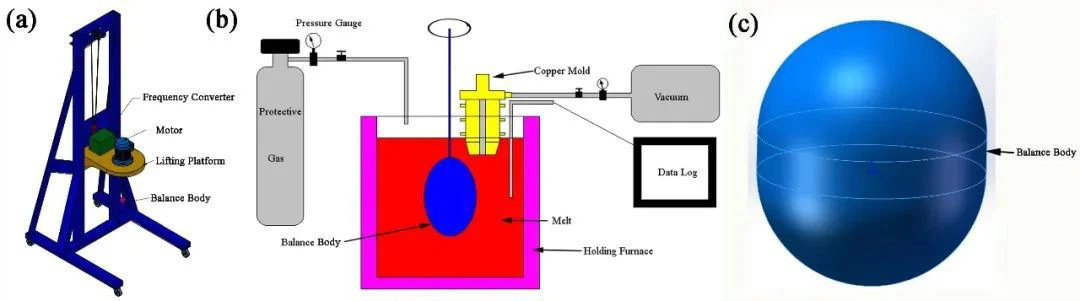
The uniform internal cooling semi-solid pulping equipment is adopted, and the main structure is shown in Figure 1. Using the high vacuum arc melting method, the Al-Ti master alloy was prepared with pure aluminum (≥99%, mass fraction, the same below), pure titanium (≥99.5%), and the mass ratio of Al to Ti was 5:9. The middle part of the alloy was sampled, and the surface of the sample was corroded after rough grinding, fine grinding and polishing. Its phase composition was analyzed by XRD, and its microstructure was observed by OM.
Taking AZ91D alloy as the matrix, its solidus temperature and liquidus temperature measured by Pandat software are 400 ℃ and 595 ℃, respectively. Ti is added to the alloy. Since Ti has a very low solubility in magnesium, it is added in the form of Al-Ti master alloy. Crush into small particles, wrap in aluminum foil and preheat to 200 ℃ for later use. The smelting temperature was set to 700 °C at first, and after the base alloy was completely melted, the temperature was kept for 15 min. During this period, the mixed gas of SF6 and CO2 was used to protect it. The Al-Ti master alloy wrapped with aluminum foil was added to the base and stirred with a graphite rod for 1 to 2 min. Make the components evenly distributed, wait until the Al-Ti master alloy is completely dissolved, cool down to 615 °C, remove the slag, put the balance body with a rotating speed of 1 400 r/min into the metal crucible, immerse the balance body, and use a temperature recorder to record the temperature data , when the temperature change does not exceed 0.1 °C, the solution temperature is considered to be stable, and the sample is cast with a copper mold. Samples were taken at a distance of 10 mm from the bottom, and the metallographic samples were etched with 4% nitric acid alcohol solution after rough grinding, fine grinding and polishing. Then use the image analysis software Image-J to quantitatively analyze the sample tissue. The grain size of the sample structure was characterized by the average equivalent diameter and the average shape factor.
2. Test results
2.1 Microstructure and phase analysis of Al-Ti master alloy
Figure 2 shows the microstructure of the Al-Ti master alloy prepared by high vacuum arc melting. It can be seen that there are black bulk phase and white network phase in the structure, and strip phase is also distributed. The distribution of these phases is uniform, and there is no agglomeration phenomenon, indicating that the Al-Ti master alloy can better refine the magnesium alloy. Figure 3 is an XRD pattern of the Al-Ti master alloy. From the analysis of Jade software, it can be seen that the black block is α2-Ti3Al phase, and the white mesh and strip are γ-TiAl phase.
2.2 Al-Ti master alloy refining AZ91D magnesium alloy slurry microstructure
2.2.1 Effect of Ti content on the microstructure of AZ91D magnesium alloy slurry
Figure 4 shows the semi-solid slurry microstructure of AZ91D magnesium alloy with different additions of Al-Ti master alloy. When the Ti-Al alloy is not added and the balance body is stirred, the AZ91D magnesium alloy slurry is poured with a copper mold. Due to the extremely fast cooling rate of the copper mold, the as-cast microstructure consists of primary α-Mg dendrites and β-Mg17Al12 distributed in the grain boundaries. Phase composition, the primary α-Mg phase dendrites are very coarse, showing an obvious six-fold symmetrical structure of magnesium alloys, and the dendrite distribution is disordered. The coarse primary α-Mg dendrites transformed into fine spherulites when the equilibrium body with a rotating speed of 1 400 r/min penetrated into the alloy melt, and the grains were obviously refined and began to become round. Maintaining a stable rotational speed of 1 400 r/min, when 0.01% Al-Ti master alloy was added, the grains were further refined and uniformly distributed. With the increase of the master alloy addition, the grain refinement is more obvious, the D is smaller, and the SF is larger and larger, indicating that the grains become fine and round. The addition of 0.1% Al-Ti master alloy has the best effect on the microstructure refinement of magnesium alloy slurry, with fine grains, large roundness and uniform distribution. At this time, the average equivalent diameter is 45.17 μm and the SF is 0.69. After that, with the increase of the addition amount of Al-Ti master alloy, the microstructure refinement effect on the AZ91D magnesium alloy slurry weakened and the grains began to aggregate, and the number and density of spherical primary α-Mg grains decreased at the same time, but compared with the casting With and without the addition of the master alloy, there is still a good refining effect.
Fig. 6 is the change curve of the microstructure D and SF of the semi-solid slurry of AZ91D magnesium alloy with the addition amount of Al-Ti master alloy. It can be seen that the average equivalent diameter and average shape factor of the AZ91D magnesium alloy semi-solid slurry with the addition of the master alloy are higher than those without the addition of the master alloy.
(a) As-cast; (b) 0%; (c) 0.01%; (d) 0.03%; (e) 0.1%; (f) 0.5%; (g) 1%
Fig.4 Slurry microstructure of primary α-Mg phase of AZ91D semi-solid magnesium alloy with different additions of Al-Ti master alloy
Fig.5 Grain average equivalent diameter and average shape factor of AZ91D magnesium alloy with different contents of Al-Ti master alloy
2.2.2 Effect of holding time on the microstructure of AZ91D magnesium alloy semi-solid slurry
Figure 6 shows the semi-solid microstructure of AZ91D magnesium alloy when the addition amount of Al-Ti master alloy is 0.1% and the holding time is 10, 20, 30, 40 and 60 min. It can be seen that when the holding time is from 10 to 30 min, the semi-solid structure has changed significantly, the D of the grains has become significantly smaller, the grains are more rounded, and the distribution becomes more uniform. At the same time, the spherical α-Mg primary phase Grains become more. However, when the holding time is prolonged, the grain size of the primary α-Mg phase begins to become coarse, and the shape of the grain is gradually irregular and aggregated. It can be seen that holding for 30 min is the most favorable for the microstructure of AZ91D magnesium alloy.
Fig. 7 is the change curve of grain structure D and SF of AZ91D magnesium alloy semi-solid slurry with holding time. It can be seen that the D of the grains is 45.17 μm, the SF is 0.69, the distribution is relatively uniform, and the overall quality of the slurry is better than other holding times.
To sum up, in a certain period of time, the heterogeneous nucleation particles produced by a certain amount of Al-Ti master alloy are certain. The longer the interaction time between the qualitative nucleation particles and the α-Mg primary phase grains is, the grain growth is suppressed, and a large amount of nucleation is more likely to be formed; when the time exceeds a certain time, the primary α-Mg phase grains can obtain enough time for a long time. At the same time, mechanical stirring makes it more difficult to separate the aggregated and precipitated primary phase particles.
Fig.6 Microstructure of AZ91D magnesium alloy with different holding time with 0.1% Al-Ti master alloy
Fig.7 Effect of holding time on grain diameter and shape factor of magnesium alloy with 0.1% addition of Al-Ti master alloy
3 Discussion
When the alloy solidifies, each grain grows from a nucleation point, and the grain size of magnesium and its alloys is generally determined by the nucleation point and cooling rate. At present, there are many methods to control the size of the semi-solid primary α-Mg phase. The refinement of adding Al-Ti alloy under the condition of uniform internal cooling and stirring is more in line with the theory of increasing the cooling rate. Figure 8 shows the cooling curves of AZ91D magnesium alloys with different Al-Ti additions during the solidification process at an internal cooling stirring speed of 1 400 r/min. It can be seen that with the addition of more and more Al-Ti alloy, the equilibrium temperature of the magnesium alloy semi-solid slurry increases, and the equilibrium temperature at 90 s with the addition of 0.1%, 0.5% and 1% is 586.9 , 588.2, 587.8 ℃, so the time required to reach the equilibrium temperature will be longer. This means that the equilibrium body with a rotating speed of 1 400 r/min needs to be stirred in the magnesium alloy solution for a longer time, which will lead to the simultaneous decrease of the number and density of the primary phase. The results showed that the primary phase coarsened during the internal cooling stirring process, and the average shape factor increased and gradually stabilized. In the process of rheological casting, the average particle size increases with time, which conforms to the law of coarsening.
Fig.8 Cooling curves of magnesium alloys with different refiner contents
In addition, grain refinement is also related to the compositional supercooling of solute elements at the front of the solid-liquid interface during the growth of nucleated grains. It is well known that Ti3Al is unstable at high temperature and dissolves at around 700 °C. In the experiment, the temperature of adding Al-Ti alloy was 700 °C, and no Ti3Al phase was observed in the subsequent semi-solid slurry structure. Therefore, it can be predicted that the Ti element exists in the solution as a solute element. The mechanism of growth limiting factor (GRF) is introduced to explain the phenomenon of grain growth limited by frontal segregation at the solid-liquid interface. The larger the GRF value, the more likely the solute is to form undercooling before the grain grows, and the greater the possibility of producing small grains. The original growth limiting factor GRF of Ti element in Mg matrix is 5.95×10⁴, which is generally considered to be an extremely effective magnesium alloy refiner. The larger GRF value indicates that during the solidification process, the solute atoms are easily enriched at the front of the solid-liquid interface, which affects the diffusion rate. Therefore, with the addition of a certain Al-Ti alloy, the Ti element will limit the grain growth and effectively refine the grain size of α-Mg. The above analysis shows that it is feasible and effective to refine the semi-solid primary α-Mg structure of AZ91D magnesium alloy by adding a certain amount of Al-Ti alloy. , and jointly refine the α-Mg structure.
4 Conclusion
(1) The Al-Ti master alloy can effectively refine the semi-solid slurry of AZ91D magnesium alloy, and the grain size is reduced from 68.32 μm to 45.17 μm.
(2) When the rotation speed of the balance body is 1 400 r/min, the addition amount of Al-Ti master alloy is 0.1%, and the temperature is kept at 700 ℃ for 30 min, a semi-solid AZ91D magnesium alloy with fine spherical shape and uniformly dispersed particles can be obtained.
(3) The size of the semi-solid slurry structure of AZ91D magnesium alloy will increase with the increase of the stirring time of the balancer. At the same time, the refining effect of the Al-Ti master alloy and the balancer stirring is mutually promoted.
Citation format: Yang Xiangjie, Fu Lianghua, Deng Baofa, et al. Preparation of AZ91D magnesium alloy semi-solid slurry by mixing Al-Ti master alloy and internal cooling [J]. Special Casting and Nonferrous Alloys, 2021, 41(12): 1453 -1457.
Research On Graphite-ceramic Composite Casting Technology Of An Aerospace Titanium Alloy Shell Casting
Material And Structure Affect Performance - 3D Printing Technology Application Of Winter Olympic Snowmobile Helmet
Related Article