
The Moving Picture Examples Explain The Material Connection Process, Which Is Worth Collecting
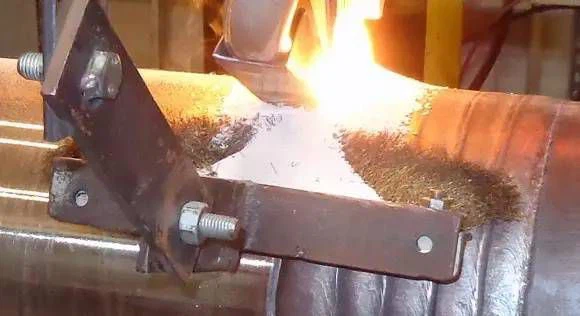
Hot air welding is also called hot air welding. Compressed air or inert gas (usual nitrogen) is heated to the required temperature by the heater in the welding gun and sprayed on the plastic surface and the steel bar so that the two are melted and combined under a small pressure. Plastics that are sensitive to oxygen (such as polyphthalamide, etc.) should use inert gas as the heating medium, and other plastics generally use filtered air. This method is often used for welding plastics such as polyvinyl chloride, polyethylene, polypropylene, polyoxymethylene, polystyrene, and carbonate.

Hot pressure welding is the use of heating and pressure to make the metal wire and the metal welding zone pressure welded together. The principle is to plastically deform the metal in the welding zone by heating and applying pressure, and at the same time destroy the oxide layer on the pressure welding interface, so that the pressure welding metal wire and the metal contact surface reach the atomic gravitational range, thereby causing the atoms to attract Force to achieve the purpose of bonding.

The hot plate welding adopts a plate-drawing structure, and the heat of the heating plate machine is transferred to the welding surface of the upper and lower plastic heating parts by the electric heating method. The surface is melted, and then the heating plate machine is quickly withdrawn. After the upper and lower heating elements are heated, the melting surfaces are fused, solidified, and integrated. The whole machine is in the form of a frame, composed of three plates: upper template, lower template, and hot template. It is equipped with hot mould and upper and lower plastic cold moulds. The action mode is pneumatic control.

Ultrasonic metal welding uses high-frequency vibration waves to be transmitted to two metal surfaces to be welded. Under pressure, the two metal surfaces are rubbed against each other to form a fusion between molecular layers. Its advantages are rapid, energy-saving, and fusion. High strength, good electrical conductivity, no sparks, close to cold processing; the disadvantage is that the welded metal parts can not be too thick (generally less than or equal to 5mm), the welding point can not be too large, and it needs to be pressurized.


Laser welding is an efficient and precise welding method that uses a high-energy-density laser beam as a heat source. It is one of the important aspects of the application of laser material processing technology. Generally, continuous laser beams are used to complete the connection of materials. The metallurgical physical process is very similar to electron beam welding, that is, the energy conversion mechanism is completed through a "key-hole" structure. The equilibrium temperature in the cavity reaches about 2500 0C, and the heat is transferred from the outer wall of the high-temperature cavity to melt the metal surrounding the cavity. The small hole is filled with high-temperature steam generated by the continuous evaporation of the wall material under the irradiation of the light beam. The light beam continuously enters the small hole, and the material outside the small hole is continuously flowing. As the light beam moves, the small hole is always in a stable state of flow. The molten metal fills the void left by the small hole and condenses with it, and the weld is formed.

Brazing (brazing) is a welding method that heats the molten filler (solder) whose melting point is lower than the workpiece to be connected to higher than the melting point, so that it has sufficient fluidity and is fully filled between the two workpieces by capillary action (called Wetting), and after it solidifies, it is a joining method that joins the two together. Traditionally in the United States, the temperature is higher than 800 ° F (427 ° C) is called brazing (brazing), and vice versa. (Soldering).

Manual welding is a welding method in which a torch, welding torch or welding tongs is held in hand.

Resistance welding is a manufacturing process and technology for joining metals or other thermoplastic materials such as plastics by heating. Pressure is applied through electrodes after the workpieces are assembled, and electric current flows through the contact surface of the joint and the adjacent area to generate resistance heat. The method of welding.

Friction welding is solid-phase welding that uses mechanical energy as an energy source. The method of using the heat generated by the friction between the end faces of the workpiece to make it reach a plastic state, and then upsetting to complete the welding.

Electroslag welding uses the resistance heat generated by the current passing through the slag as a heat source to melt the filler metal and the base metal, and form a solid connection between the metal atoms after solidification. At the beginning of welding, short-circuit the welding wire and the welding trough to start the arc, continuously add a small amount of solid flux, and use the heat of the arc to melt it to form liquid slag. When the slag reaches a certain depth, increase the feeding speed of the welding wire, and The voltage is reduced, the welding wire is inserted into the slag pool, the arc is extinguished, and the welding process of electro slag welding is transferred. Electroslag welding mainly includes melting nozzle electro slag welding, non-melting nozzle electro slag welding, wire electrode electro slag welding, plate electrode electro slag welding and so on. Its disadvantages are that the input heat is large, the joint stays for a long time at high temperature, the vicinity of the weld is easy to overheat, the weld metal is a coarse crystalline as-cast structure, and the impact toughness is low. The weldment generally needs to be normalized and returned after welding. Fire heat treatment.

High-frequency welding uses solid resistance heat as an energy source. During welding, the resistance heat generated in the workpiece by the high-frequency current is used to heat the surface of the welding area of the workpiece to a molten or close plastic state, and then the upsetting force is applied (or not) to realize the metal bonding.

Riveting refers to the method of connecting two plates or objects together by drilling holes in their parts, then putting rivets in, and riveting the rivets with a rivet gun.

Hot melt A connection method that is heated to a (liquid) melting point.

Flow Pattern Of Injection Defect
Common Problems And Improvement Methods in CNC Machining One, The Workpiece Is Overcut
Related Article



