
The High-definition Metallographic Spectrum Of Aluminium And Aluminium Alloys
Collect! the High-definition Metallographic Spectrum of Aluminium and Aluminium Alloys
Aluminium alloy is the most widely used non-ferrous metal structural material in the industry, and it has been widely used in aviation, aerospace, automobile, machinery manufacturing, shipbuilding and chemical industries. With the rapid development of the industrial economy, the demand for aluminium alloy welded structural parts is increasing, and the weldability of aluminium alloy is also studied in depth. At present, aluminium alloy is the most used alloy.
Pure aluminium is divided into smelted products and pressure processed products. The former is represented by the chemical composition Al, and the latter is represented by the Chinese Pinyin LV (aluminium, industrial). According to the processing method, aluminium alloys can be divided into two categories: deformable aluminium alloys and cast aluminium alloys:
The deformed aluminium alloy can withstand pressure processing. It can be processed into various shapes and specifications of aluminium alloy materials. Mainly used in the manufacture of aviation equipment, doors and windows for construction, etc. Deformable aluminium alloys are divided into non-heat-treatable reinforced aluminium alloys and heat-treatable reinforced aluminium alloys. The non-heat-treatable strengthened type cannot be improved by heat treatment, but can only be strengthened by cold working deformation. It mainly includes high-purity aluminium, industrial high-purity aluminium, industrial pure aluminium, and rust-proof aluminium. Heat-treatable reinforced aluminium alloys can improve mechanical properties through heat treatment methods such as quenching and aging. It can be divided into duralumin, forged aluminium, super-duralumin, and special aluminium alloys.
Cast aluminium alloys can be divided into aluminium-silicon alloys, aluminium-copper alloys, aluminium-magnesium alloys, aluminium-zinc alloys and aluminium-rare-earth alloys according to their chemical composition. Among them, aluminium-silicon alloys include hyper eutectic silicon aluminium alloys, eutectic silicon aluminium alloys, and monolithic alloys. Crystalline silicon aluminium alloy, cast aluminium alloy is used in the as-cast state.
Aluminium alloy deformation aluminium alloy
One series: 1000 series aluminium alloy represents 1050, 1060, 1100 series. In all series, the 1000 series belongs to the series with the most aluminium content. The purity can reach more than 99.00%. Because it does not contain other technical elements, the production process is relatively simple and the price is relatively cheap. It is currently the most commonly used series in conventional industries. Most of the products circulating in the market are the 1050 and 1060 series. The 1000 series aluminium plate determines the minimum aluminium content of this series according to the last two Arabic numerals. For example, the last two Arabic numerals of the 1050 series are 50. According to the international brand naming principle, the aluminium content must reach 99.5% or more to be a qualified product. my country's aluminium alloy technical standard (GB/T3880-2006) also clearly stipulates that the aluminium content of 1050 reaches 99.5%. In the same way, the aluminium content of 1060 series aluminium plates must reach 99.6% or more.
The second series: 2000 series aluminium alloy represents 2024, 2A16 (LY16), 2A02 (LY6). The 2000 series aluminium plate is characterized by high hardness, with the highest content of copper, which is about 3-5%. The 2000 series aluminium rods are aviation aluminium materials and are not often used in conventional industries.
Three series: 3000 series aluminium alloy represents mainly 3003 and 3A21. my country's 3000 series aluminium plate production process is relatively excellent. 3000 series aluminium rods are made of manganese as the main component. The content is between 1.0-1.5, which is a series with a better anti-rust function.
Four series: 4000 series aluminium rods are represented as 4A01 4000 series aluminium plates belonging to the series with the higher silicon content. Usually, the silicon content is between 4.5-6.0%. It belongs to construction materials, forging materials for mechanical parts, welding materials; low melting point, good corrosion resistance, product description: heat-resistant and wear-resistant
Five series: 5000 series aluminium alloy represents 5052, 5005, 5083, 5A05 series. The 5000 series aluminium rods belong to the more commonly used alloy aluminium plate series, the main element is magnesium, and the magnesium content is between 3-5%. It can also be called an aluminium-magnesium alloy. The main features are low density, high tensile strength, high elongation, and good fatigue strength, but they cannot be strengthened by heat treatment. In the same area, the weight of aluminium-magnesium alloy is lower than other series. It is also widely used in conventional industries. In my country, the 5000 series aluminium sheet is one of the more mature aluminium sheet series.
Six series: 6000 series aluminium alloy represents 6061, which mainly contains magnesium and silicon. Therefore, the advantages of the 4000 series and 5000 series are concentrated. 6061 is a cold-treated aluminium forging product, suitable for applications with high requirements for corrosion resistance and oxidation. Good workability, easy coating and good processability.
Seven series: 7000 series aluminium alloy represents 7075 and mainly contains zinc. It also belongs to the aerospace series. It is an aluminium-magnesium-zinc-copper alloy and a heat-treatable alloy. It is a super hard aluminium alloy with good wear resistance. It also has good weldability but poor corrosion resistance.
Eight series: The more commonly used 8000 series aluminium alloy is 8011, which belongs to other series, and most of the applications are aluminium foil. It is not commonly used in the production of aluminium rods.
Nine series: 9000 series aluminium alloy is a spare alloy.
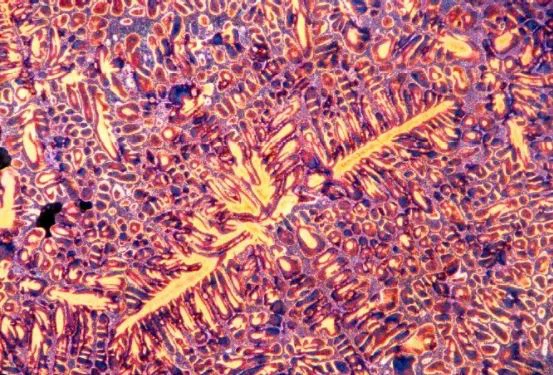
Appreciation of Aluminum and Aluminum Alloy Metallography
Reagents
---------------------------------------------------------------------------------------------------------------
Keller s Reagent:
95 mL distilled water, 2.5 mL HNO3, 1.5 mL HCl, 1.0 mL HF
Weck s Reagent:
100mL distilled water, 4g KMnO4, 1g NaOH
----------------------------------------------------------------------------------------------------------------
|
Material |
High purity aluminium |
|
Craft |
- |
|
Etching agent |
Barker’s reagent |
|
Magnification |
50X |
|
Observation method |
Orthogonally polarized light + sensitive colour film |
|
Material |
1100 Al |
|
Craft |
Continuous cast |
|
Etching agent |
Weck’s reagent |
|
Magnification |
200 μm |
|
Observation method |
Orthogonally polarized light + sensitive colour film |
|
Material |
1100 |
|
Craft |
Continuous casting |
|
Etching agent |
Barker’s reagent |
|
Magnification |
50X |
|
Observation method |
Orthogonally polarized light + sensitive colour film |
|
Material |
1100 |
|
Craft |
Forging |
|
Etching agent |
Barker’s reagent |
|
Magnification |
50X |
|
Observation method |
Orthogonally polarized light + sensitive colour film |
|
Material |
1350 Al |
|
Craft |
Forging,(Extrusion) |
|
Etching agent |
Barker’s reagent |
|
Magnification |
50X |
|
Observation method |
Orthogonally polarized light + sensitive colour film |
|
Material |
Al-4%Cu |
|
Craft |
Solution Annealing+Aging (552℃,1h+water quenching, 371℃,1h+air cooling) |
|
Etching agent |
Barker’s Reagent |
|
Magnification |
aqueous 0.5% HF |
|
Staff Gauge |
10 μm |
|
Material |
Al-4.5%Cu |
|
Craft |
Casting |
|
Etching agent |
Weck’s reagent |
|
Magnification |
50X |
|
Observation method |
Orthogonally polarized light + sensitive colour film |
|
Material |
Al-5.5%Cu |
|
Craft |
Forging, T3 |
|
Etching agent |
Barker’s reagent |
|
Magnification |
50X |
|
Observation method |
Orthogonally polarized light + sensitive colour film |
|
Material |
Al-4.6%Cu-0.7%Si-0.3Fe-0.7%Mg-0.7%Mn |
|
Craft |
Extrusion |
|
Etching agent |
Keller’s reagent |
|
Magnification |
50X |
|
Staff Gauge |
100 μm |
|
Material |
Al-4.6%Cu-0.7%Si-0.3Fe-0.7%Mg-0.7%Mn |
|
Craft |
Extrusion |
|
Etching agent |
aqueous 0.5% HF |
|
Staff Gauge |
10 μm |
|
Remark |
CuAl2、(FeMn)Al6、Mg2Si |
|
Material |
Al-4.4%Cu-1.5%Mg-0.6%Mn |
|
Craft |
Casting |
|
Etching agent |
aqueous 0.5% HF |
|
Staff Gauge |
100 μm |
|
Remark |
Coarse Nascent Compound |
|
Material |
Al-4.4%Cu-1.5%Mg-0.6%Mn |
|
Craft |
Casting |
|
Etching agent |
aqueous 0.5% HF |
|
Staff Gauge |
20 μm |
|
Remark |
- |
|
Material |
Al-4.4%Cu-1.5%Mg-0.6%Mn |
|
Craft |
Forging, 2024-F |
|
Etching agent |
Keller’s reagent |
|
Staff Gauge |
20 μm |
|
Remark |
Cross-section |
|
Material |
Al-3.2%Mg-0.4%Mn+Cr |
|
Model |
5754 |
|
Craft |
Casting,5754-F |
|
Staff Gauge |
1000 μm |
|
Etching agent |
Barker’s reagent |
|
Material |
Al-0.5%Mg-0.8%Si |
|
Grade |
6005 |
|
Craft |
Casting |
|
Etching agent |
Barker’s reagent |
|
Gain |
50X |
|
Observation method |
Orthogonally polarized light + sensitive colour film |
|
Material |
Al-0.5%Mg-0.8%Si |
|
Model |
6005 |
|
Craft |
Casting,6005-T5 |
|
Staff Gauge |
10 μm |
|
Etching agent |
Keller’s reagent |
|
Material |
Al-1.0%Mg-0.6%Si-0.2%Cr-0.27%Cu |
|
Model |
6001 |
|
Craft |
Forging,6061-F |
|
Staff Gauge |
100 μm |
|
Etching agent |
Barker’s reagent |
|
Material |
Al-0.7%Mg-0.4%Si |
|
Model |
6003 |
|
Craft |
Casting,6063-T5 |
|
Staff Gauge |
10 μm |
|
Etching agent |
Aqueous 0.5% HF |
|
Material |
Al-1.5%Mg-5.5%Zn-0.12%Zr |
|
Model |
7021 |
|
Craft |
Casting, 7021-O, (plate) |
|
Staff Gauge |
20 μm |
|
Etching agent |
Aqueous 0.5% HF |
|
Material |
Al-2.3%Cu-2.3%Mg-6.2%Zn-0.12%Zr |
|
Grade |
7050 |
|
Craft |
Casting, annealing (426℃, 3h, slow cooling to 232℃, heat preservation 6h, air cooling) |
|
Etching agent |
Keller’s reagent |
|
Rulers |
20 μm |
|
Remark |
16 HRB |
|
Material |
Al-2.3%Cu-2.3%Mg-6.2%Zn-0.12%Zr |
|
Grade |
7050 |
|
Craft |
Casting, 7050-T74 |
|
Etching agent |
Keller’s reagent |
|
Rulers |
20 μm |
|
Remark |
88 HRB |
|
Material |
Al-1.6%Cu-2.5%Mg-5.6%Zn-0.23%Cr |
|
Grade |
7075 |
|
Craft |
Casting, 7075-T74 |
|
Etching agent |
Barker’s reagent |
|
Rulers |
50 μm |
|
Remark |
Orthogonally polarized light + sensitive colour film |
|
Material |
Al-7%Si-0.3%Mg-<0.2%Fe |
|
Grade |
A356 |
|
Craft |
Casting |
|
Etching agent |
Barker’s reagent |
|
Rulers |
50 X |
|
Remark |
Orthogonally polarized light + sensitive colour film |
|
Material |
Al-7%Si-0.3%Mg-<0.2%Fe |
|
Grade |
A356 |
|
Craft |
Casting |
|
Etching agent |
Barker’s reagent |
|
Rulers |
50 X |
|
Remark |
Orthogonally polarized light + sensitive colour film |
|
Material |
Al-7%Si-0.3%Mg-<0.2%Fe |
|
Grade |
A356 |
|
Craft |
Casting |
|
Etching agent |
Keller’s reagent |
|
Magnification |
50 X |
|
Remark |
Polarized light + sensitive colour film |
|
Material |
Al-7%Si-0.3%Mg-<0.2%Fe |
|
Grade |
A356 |
|
Craft |
Casting |
|
Etching agent |
Weck’s reagent |
|
Magnification |
200 X |
|
Remark |
Polarized light + sensitive colour film |
|
Material |
Al-7%Si-0.3%Mg-<0.2%Fe |
|
Grade |
A356 |
|
Craft |
This cast and Thixoformed |
|
Etching agent |
Weck’s reagent |
|
Magnification |
200 X |
|
Remark |
Polarized light + sensitive colour film |
|
Grade |
A357 |
|
Craft |
Semi-solid thixotropic die-casting forming |
|
Etching agent |
Weck’s reagent |
|
Magnification |
200 X |
|
Remark |
Brightfield |
|
Material |
Al-11.6%Si-0.6%Fe |
|
Craft |
Casting |
|
Etching agent |
Weck’s reagent |
|
Magnification |
100 X |
|
Remark |
Cross polarized light |
|
Material |
Al-7.15%Si |
|
Craft |
Casting |
|
Etching Agent |
0.5% HF Solution |
|
Staff Gauge |
50 μm |
|
Material |
Al-7.12%Si |
|
Craft |
Casting |
|
Etching agent |
Weck’s reagent |
|
Staff Gauge |
50 μm |
|
Observation method |
Polarized light + sensitive colour film |
|
Material |
Al-11.8%Si |
|
Craft |
Casting |
|
Etching agent |
aqueous 0.5% HF |
|
Staff Gauge |
50 μm |
|
Remark |
alpha dendrites and an alpha-Si eutectic |
|
Material |
Al-11.7%Si |
|
Craft |
Casting |
|
Etching agent |
Weck’s reagent |
|
Ruler |
200 μm |
|
Observation method |
Polarized light + sensitive colour film |
|
Material |
Al-19.85%Si |
|
Craft |
Casting |
|
Etching agent |
aqueous 0.5% HF |
|
gain |
500X |
|
Remark |
Eutectic Si |
|
Material |
Al-19.85%Si |
|
Craft |
Casting |
|
Etching agent |
Weck’s reagent |
|
gain |
200X |
|
Remark |
Eutectic Si |
|
Material |
Al-4.6%Cu-0.3%Mg-0.3%Mn |
|
Grade |
201 |
|
Craft |
Casting |
|
Etching agent |
Weck’s reagent |
|
Ruler |
100 μm |
|
Observation method |
Orthogonal Polarized Light |
|
Material |
Al-6.0%Si-3.5%Cu |
|
Grade |
319 |
|
Craft |
Casting |
|
Etching agent |
Weck’s reagent |
|
Ruler |
100 μm |
|
Observation method |
Orthogonal |
|
Material |
Al-6.0%Si-3.5%Cu |
|
Grade |
319 |
|
Craft |
Casting |
|
Etching agent |
Weck’s reagent |
|
Ruler |
100 μm |
|
Observation method |
Orthogonal |
|
Material |
Al-6.0%Si-3.5%Cu |
|
Grade |
319 |
|
Craft |
Casting |
|
Etching agent |
Keller’s reagent |
|
Ruler |
50 μm |
|
Observation method |
- |
|
Material |
Al-7.3%Si-0.4%Mg |
|
Craft |
Casting |
|
Etching agent |
Weck’s reagent |
|
放大倍数 |
100X |
|
Observation method |
Orthogonally polarized light + sensitive colour film |
|
Material |
Al-7%Si-0.3%Mg-<0.2%Fe |
|
Grade |
A356 |
|
Craft |
Casting |
|
Etching agent |
Weck’s reagent |
|
gain |
200X |
|
Observation method |
Orthogonal polarized light + sensitive color film |
|
Material |
Al-7%Si-0.5%Mg |
|
Grade |
A357 |
|
Craft |
Casting, 357-T6 |
|
Etching agent |
aqueous 0.5% HF |
|
Ruler |
20 μm |
|
Material |
Al-5%Si-1.2%Cu-1.0%Mg |
|
Craft |
Casting |
|
Etching agent |
Weck’s reagent |
|
Ruler |
50 μm |
|
Material |
Al-33%Cu |
|
Craft |
Casting |
|
Etching agent |
1g钼酸铵,6gAmmonium Chloride,200mL水 |
|
gain |
1000X |
|
Remark |
AlCu2 |
Differential Pressure Casting Of Large Complex Magnesium Alloy Shell Castings
The Role Of Elements In 7A03, 7A04, 7A09 And 7005, 7075, 7475, 7050, 7055 Alloys
Related Article



