
Knowledge Of Tooling, Fixtures, And Gauges
Author: SZTC
2024-06-22
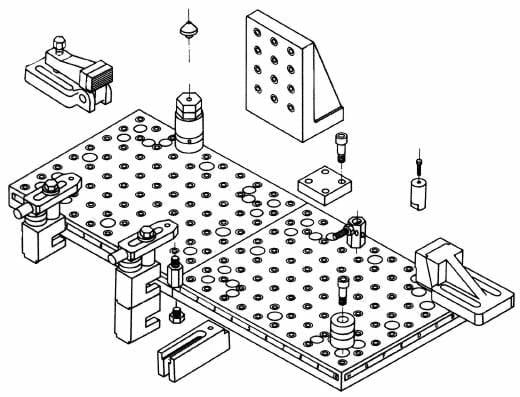
Knowledge Of Tooling, Fixtures, And Gauges
The design of tooling, fixtures, and gauges is to improve the batch production efficiency of mechanical products, ensure the stability of product quality, and thus reduce production costs. Therefore, in the design process, this goal must be obeyed unconditionally. In the design considerations, tooling, fixtures, and gauges are usually used for single-piece and set production, but the service life is generally long. Mold tooling mainly considers service life, maintenance conditions, etc., while fixture tooling mainly considers ease of use, safety, efficiency, and reliability, and gauge tooling mainly considers ease of use, reliability, and convenient maintenance. Considering the cost issue, when designing tooling, fixtures, and gauges, the cost factor should give way to safety, efficiency, reliability, life, and convenience.
Material selection standards are another important consideration in the design process. When designing, mature standardized parts should be used as much as possible, such as guide columns, guide sleeves, fasteners, springs, hardware, cylinders, hydraulic cylinders, standard mold frames, quick chucks, etc. For the design of main parts, it is necessary to carefully design the types of metal materials and heat treatment, such as tempering, high frequency, carburizing and quenching, nitriding and quenching, etc., as well as hardness selection, especially considering the prevention of deformation of parts after heat treatment. Parts that rub against each other need to consider hardness matching and necessary lubrication measures. The thickness and type of the surface treatment should be carefully designed according to the function of the parts, such as galvanizing, nickel plating, bright chrome plating, anodizing, hard anodizing, etc.
The basic points of tooling, fixtures, and inspection fixtures design include the clamping method of mechanical parts and the three principles of clamping after the parts are positioned in the fixture. Among them, the clamping method includes direct alignment clamping and line alignment clamping. The former has low efficiency but high alignment accuracy, which is suitable for single-piece small batch and simple-shaped workpieces; while the latter has good versatility, but low efficiency and low accuracy, which is suitable for single-piece small batch and complex-shaped castings. In the three principles of clamping, the direction of the clamping force should be selected to point to the positioning reference (first reference), and the magnitude of the clamping force should be sufficient to balance the influence of other forces to ensure that the parts will not move during processing.
In short, the design of tooling, fixtures, and inspection tools needs to fully consider multiple factors such as efficiency, quality, cost, and safety to ensure that the batch production of mechanical products can achieve the expected goals.
b. The principle of non-deformation of parts after positioning in the tooling fixture: During the processing, in order to avoid the deformation of parts that do not match the precision due to the clamping force, we need to select a suitable clamping position, adjust the contact state between the pressure plate and the part, and apply appropriate clamping force. In this way, the part can maintain its original accuracy and shape during the processing.
c. The principle of non-vibration of parts after positioning in the tooling fixture: In order to ensure that the support and clamping system maintains sufficient rigidity, we set the clamping position as close as possible to the processing area of the part to avoid vibration of the part and the clamping system. For the fixture used for rough processing, we mainly consider the principle of non-movement of the part, while for the fixture used for fine processing, we pay more attention to the principle of non-deformation and non-vibration of the part.
Injection Mold Design Expert
Functions Of 1-8 Series Aluminum Alloys
Related Article

Fast sampling is the fastest way to win business in the hardware machining and plastic mold industries. Customers want a working sample in days, and a 3D printer delivers it, but only when you know how to print in 3d correctly.
how to print in 3d

Fast sampling is the fastest way to win business in the hardware machining and plastic mold industries. Customers often send an STL file and expect a working sample in days.
how to print an stl file

