Electroplating Process Of Plastic Products (water Electroplating And Vacuum Electroplating) There Are Two Common Electroplating Processes For Plastic Products: Water Electroplating And Vacuum Ion Plating.
Electroplating process of plastic products (water electroplating and vacuum electroplating)
There are two common electroplating processes for plastic products: water electroplating and vacuum ion plating.
1. Water electroplating:
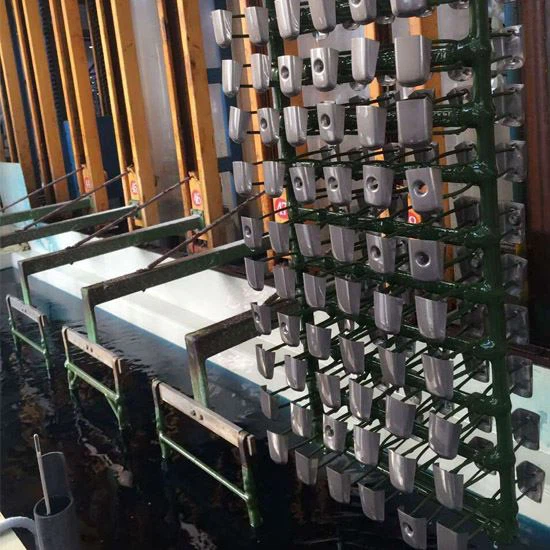
Generally applicable to ABS material, ABS+PC material products. The main process is to put the products to be electroplated into the electroless plating solution for electroplating.
According to the different needs of customers, it can be plated in different colors, such as high-gloss silver, sub-silver, and gray-silver. Because the conductivity of the electroplated product is significantly enhanced, what about some parts that need to be insulated? There are two ways: First, apply insulating oil to the part that needs to be insulated, so that the part will not be electroplated during electroplating, so as to achieve the insulation effect! Of course, the part coated with insulating oil will turn black, and it is not suitable for the appearance surface. Second, use special adhesive tape to protect the parts that need to be electroplated, and also achieve the effect of insulation.
2. Vacuum ion plating, also known as vacuum coating:
Generally applicable to a wide range, such as ABS material, ABS+PC material, PC material products. At the same time, the unit price is more expensive than water electroplating due to its complex process flow, high environment and equipment requirements. Here is a brief introduction to its technological process: product surface cleaning, antistatic --> spray primer --> baking primer --> vacuum coating --> spray finish --> bake finish --> packaging .
Vacuum electroplating can be divided into general vacuum electroplating, UV vacuum electroplating and special vacuum electroplating;
Processes include evaporation, sputtering, gun color and so on.
3. The difference between the two processes:
Water electroplating is widely used because the process is relatively simple, and the requirements from equipment to environment are not as harsh as vacuum ion plating. Such suppliers are easy to find in Dongguan. There are not many excellent suppliers of vacuum electroplating in Dongguan and Shenzhen, at least I don't have much information on such suppliers at present. However, water electroplating has a weakness, only ABS material and ABS+PC material can be plated (the effect of this material plating is not very ideal). The temperature resistance of ABS material is only 80 ℃, which limits its application range. However, vacuum plating can reach about 200 °C, which can be used for electroplating of parts used at high temperatures. For example, the tuyere and tuyere ring use PC material, and these parts are required to withstand high temperature of 130 °C. In addition, for parts that generally require high temperature resistance, a layer of UV oil should be sprayed at the end of vacuum plating, so that the surface of the product is shiny, resistant to high temperature, and at the same time ensures adhesion.
4. The advantages and disadvantages of the two processes:
A. To put it simply, if vacuum electroplating is inferior to UV oil, its adhesion is very poor and cannot exceed 100 grids of TEST, while water electroplating is obviously better than vacuum electroplating! Therefore, in order to ensure the adhesion of vacuum electroplating, special spraying treatment is required in the follow-up, and the cost is of course higher.
B. The color of water electroplating is relatively monotonous, generally only a few such as bright silver and sub-silver. However, vacuum plating can solve the problem of seven colors.
C.
The general coating material of water electroplating uses "hexavalent chromium", which is a non-environmental material. The requirements for "hexavalent chromium" are as follows:
EU: 76/769/EEC: prohibited; 94/62/EC: <100ppm;
ROHS: <1000ppm
With such strict requirements, some domestic manufacturers have begun to try to use "trivalent chromium" to replace "hexavalent chromium"; while the coating materials used in vacuum electroplating are widely used and are easy to meet environmental protection requirements.
Light And Safe, Thermoforming Technology Tells You What Is The Black Technology Of One-piece Car Body?
Do You Know The Reasons For The Difficulty in Making Injection Molds? The Cavity And The Core Are Three-dimensional.
Related Article