
Microstructure And Properties Of Cold-deformed NSSC 2120 Duplex Stainless Steel in Investment Casting
The results show that the two-phase ratios (α/γ) of ferrite and austenite gradually increase when annealed at 950~1200 ℃, and the layered austenite structure transforms into small islands; the α fibre texture and The γ fibre texture component gradually formed and strengthened; as the annealing temperature increased, the tensile strength of the material gradually decreased, the elongation first increased and then decreased, and the corrosion resistance first decreased and then increased. After annealing at 1000℃, the cold-deformed dual-phase steel has the best mechanical properties, and its tensile strength and elongation are 730 MPa and 58% respectively; after annealing at 1200℃, the corrosion current density of the material is the lowest value of 2.5μA•cm-2, Its corrosion resistance is the strongest and has obvious Brass texture and other recrystallized texture components.
Duplex stainless steel is a type of steel in which the ferrite phase (α) and the austenite phase (γ) in the solid solution structure each account for about half. DSS combines the good toughness and weldability of austenitic stainless steel and the higher strength and chloride corrosion resistance of ferritic stainless steel. In recent years, DSS has been widely used in the military industry, oil and gas industry, fertilizer industry, bridge construction, marine industry and chemical tanker industries. Duplex stainless steel shows two development trends: one is to give full play to the high strength and good corrosion resistance of duplex stainless steel and to develop super duplex stainless steels such as 2750 and 2906 to replace super austenitic stainless steels such as 904L; Give full play to the resource-saving advantages of duplex stainless steel and develop economical duplex stainless steels such as UNS S32304 and LDX 2101. The energy-saving duplex stainless steel uses low-cost N, Mn and other elements to replace the traditional duplex stainless steel Ni, Mo and other precious metals, which reduces the cost while making its yield strength twice that of ordinary austenitic stainless steel, and retains Excellent corrosion resistance. Compared with the traditional duplex stainless steel, due to the increase of N content, the precipitation of σ phase is suppressed to a certain extent, but at the same time the precipitation of nitrides such as Cr2N is also promoted, which makes the thermal plasticity of the economical duplex stainless steel lower, and the hot deformation process of rolling Medium cracking is more serious, so solving the problem of thermoplasticity is very important to the production of economical duplex stainless steel.
In 2014, Nippon Steel & Sumikin Stainless Steel Co., Ltd. successfully developed for the first time a new economical duplex stainless steel NSSC 2120 (21Cr-2Ni-3Mn-1Cu-N) that can significantly improve welding performance and replace SUS304 stainless steel. Compared with SUS304 stainless steel, NSSC 2120 has Good welding performance and improved strength
Doubled, but also has the advantage of low cost. As a mature technology, cold deformation processing has high dimensional accuracy, good surface quality, and stable structure, which can effectively avoid defects generated during thermal processing and ensure good material performance. At present, there are few types of research on the evolution of microstructure and properties of cold-deformed energy-saving duplex stainless steel after annealing and heat treatment. In this project, the effect of recrystallization annealing on the microstructure and properties of cold-deformed duplex stainless steel is studied by performing high-temperature annealing heat treatment of a certain cold-deformed NSSC 2120 duplex stainless steel at different temperatures and times.
1 Test materials and methods
The NSSC 2120 duplex stainless steel cast billet is prepared by the investment casting process and the intermediate frequency induction furnace. The chemical composition is shown in Table 1. The smelted as-cast 2120 duplex stainless steel is subjected to solution treatment in the SXL-1400C box heat treatment furnace, the solution temperature is 1100 ℃, and the heat is kept for 2 hours to water quench. After solid solution, the sample was cut into 10mm thick samples, and then cold rolled with a φ200mm×200mm two-roll mill at a speed of 2.5m/min for multiple passes, the pass reduction was 0.5mm, and the cold rolling deformation Is 70%. After that, the samples were annealed at 950, 1000, 1050, 1100, 1150, and 1200℃ in a box-type resistance furnace. The annealing time was 30 minutes and then water was quenched (the codes were RA-950, RA-1000, RA-1050, RA -1100, RA-1150, RA-1200).

2 Test results and analysis
2.1 The effect of annealing temperature on microstructure and texture
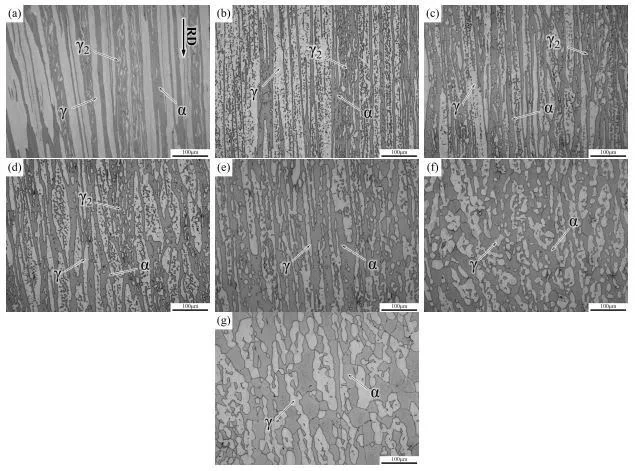
Figure 1 shows the microstructure of NSSC 2120 duplex stainless steel cold rolled and annealed at different temperatures. It can be seen from Figure 1a that the TD surface of the sample after being cold rolled with 70% deformation is α/γ (austenite/ferrite) two-phase structure, which is elongated in the rolling direction into a lath. The fine needle-like secondary austenite (γ2) phase is dispersed among the austenite laths, and the grains in the dual-phase structure are obviously refined or even broken. Due to the uneven shape and size of the two-phase structure in the solid solution state, the hardness of the two phases is also different. The width of the two-phase layered structure after large deformation cold rolling is uneven, and the phase ratio of α and γ after cold deformation is about 40.1% And 59.9%. It can be seen from Figure 1 that no obvious precipitates are found in the metallographic structure after annealing at 950°C and at higher temperatures, and the higher annealing temperature dissolves the precipitated phases such as Cr2N. After annealing at 950℃, fine α-phase crystal grains nucleated in the γ-phase layered structure. As the annealing temperature increases, the α-phase crystal grains formed by recrystallization nucleation continue to merge, and the slab fibrous γ-phase structure fractures and breaks. , The dispersed γ2 phases are entangled, merged, and distributed in chains along the rolling direction. When the annealing temperature reaches 1150℃, 1200℃, the γ phase basically transforms into discontinuous islands and is distributed on the α matrix. The two-phase distribution is more uniform, and the two phases also change significantly. The α-phase grains are obviously grown and merged. Smaller γ grains.

(a)CR;(b)RA-950;(c)RA-1000;(d)RA-1050;(e)RA-1100;(f)RA-1150;(g)RA-1200
Figure 1 The microstructure of cold rolled and different recrystallization annealing temperatures
Image-Pro software was used to measure the volume fraction of the two-phase structure after annealing, and 15 fields of view were measured for each material to calculate the average value. The results are shown in Figure 2. It can be seen from Figure 2 that after annealing at 950℃, the γ phase ratio has dropped to about 56%. As the annealing temperature increases, the γ phase volume fraction gradually decreases, and the α phase volume fraction increases accordingly. When the recrystallization annealing temperature rises to 1200℃, γThe phase ratio drops to 39%

Figure 2 Changes of γ phase ratio at different recrystallization annealing temperatures
Figure 3 shows the EBSD reconstruction images of cold-rolled duplex stainless steels annealed at 950, 1000, 1100, and 1200°C. The white grains are α grains, the grey grains are γ grains, the fine line is the low-angle grain boundary (LAGBS, 2~15°), the deep line is the high-angle grain boundary (HAGBS, ≥15°), the thin dashed line It is the twin boundary (TWINS). It can be seen from Figure 3 that after the recrystallization annealing, the fine γ recrystallized grains are distributed in layers along the rolling direction, the fine α grains are distributed between the austenite islands, and there are long strips of annealing in the γ grains. Twins, α-phase due to the higher stacking fault energy after deformation, is not easy to form twins. After recrystallization annealing, the γ and α grains are surrounded by high-angle grain boundaries, and there are small-angle grain boundaries at a small number of sub-grains, indicating that the cold-rolled dual-phase steel has been completely recrystallized. Fine α recrystallized grains can be observed in the γ islands of the annealed samples at 950℃. As the annealing temperature increases, the grains merge and grow significantly. The layered austenite islands grow and self-contain due to the wrapped α grains. When the annealing temperature is increased to 1200℃, the two-phase recrystallized grains are uniformly distributed along the rolling direction due to the pinning effect of the γ phase.

(a) RA-950; (b) RA-1000; (c) RA-1100; (d) RA-1200
Figure 3 EBSD reconstruction of samples at different annealing temperatures

Table 2 shows the ratio of large and small-angle grain boundaries, twin grain boundaries and heavy-site lattice grain boundaries of cold-rolled duplex stainless steel samples annealed at 950, 1000, 1100 and 1200 ℃.
Figure 4 shows the average size of FCC and BCC phase crystal grains of cold-rolled duplex stainless steel at different annealing temperatures.

(a) RA-950; (b) RA-1000; (c) RA-1100; (d) RA-1200
Figure 3 EBSD reconstruction of samples at different annealing temperatures
2.1.1 The effect of annealing temperature on texture
Figure 5 is the ODF (φ2=0°, 45°, 65°) cross-sectional view of the α and γ structures of the annealed samples at 950, 1000, 1100 and 1200 ℃ with Euler angles φ1 and Φ as the horizontal and vertical coordinates. The typical texture components in the cubic metal ODF diagram are shown in Figure 6. The deformation texture is represented by a triangle, the recrystallized texture is represented by a square, and the sheer texture is represented by a circle.
Figure 5 Texture evolution characterized by ODF Euler space in austenite and ferrite structures of different annealed samples


Figure 6 Typical texture components of cubic metal
2.2 The effect of recrystallization annealing on mechanical properties
Figure 7 shows the tensile test results of cold-rolled NSSC 2120 duplex stainless steel samples at different recrystallization annealing temperatures at room temperature.

Figure 7 Tensile strength and elongation of cold-rolled 2120 dual-phase steel at different recrystallization annealing temperatures
2.3 The effect of recrystallization annealing on corrosion resistance
Figure 8 shows the potential polarization curves of cold-rolled NSSC 2120 duplex stainless steel samples at different recrystallization annealing temperatures in artificial seawater (25.54g/L NaCl + 11.10g/LMgCl2+ 4.09g/L Na2SO4+1.16g/LCaCl2). The corresponding self-corrosion potential (Ecorr), pitting location (Epit) and corrosion current density (Icoor) are shown in Table 3.

Figure 8 Polarization curves of cold-rolled 2120 dual-phase steel at different recrystallization annealing temperatures

Figure 9 shows the pitting morphology of cold-rolled NSSC 2120 duplex stainless steel samples at different recrystallization annealing temperatures. It can be seen from Figure 9 that pitting corrosion mainly occurs in the α/γ phase boundary and the α matrix. The pits in the severely pitted areas develop into the γ phase. The size of the pits on the surface of the RA-1050 and RA-1100 samples is relatively large. Large, the size of the corrosion holes on the surface of the RA-1200 sample is smaller and the corrosion resistance is the strongest. The pitting corrosion on the surface of RA-950 and RA-1000 samples occurred in the broken γ, γ2 and α, and the small two-phase grains caused the corrosion pits to extend to the austenite inward. The pitting morphology of the samples at different annealing temperatures is basically consistent with the corrosion current density results measured by the polarization curve. In the Cl- environment, the α phase always corrodes preferentially. As the recrystallization annealing temperature increases, the α phase ratio in cold-rolled dual-phase steel increases (see Figure 2), and the pitting corrosion resistance of the sample does not gradually decrease. This is because the two-phase structure of the sample is still growing along the rolling direction when annealed at 950 or 1000 ℃, the two-phase grain size is small, the grain boundary distribution is dense (see Figure 3), and the grain boundary size is small and more Cause corrosion to occur preferentially along the grain boundaries. A large number of low ∑CSL grain boundaries greatly reduce the content of vacancy defects and impurity elements on the phase boundary, cut off the connectivity of the grain boundary, and reduce the corrosion rate of the grain boundary. Therefore, a large amount of ∑3-grain boundary after annealing improves the cold-rolled double Corrosion resistance of phase steel grain boundaries. And with the increase of the recrystallization temperature, the degree of recrystallization is further improved, the two-phase grains merge and grow, the ratio of the large-angle grain boundary and the heavy site grain boundary increases, the two-phase structure distribution is more uniform, the matrix defects are reduced, and the passivation is achieved. The stability of the film is enhanced, and the corrosion resistance is improved.

(a)RA-950 (b)RA-1000 (c)RA-1050 (d)RA-1100 (e)RA-1150 (f)RA-1200
Fig. 9 Pitting morphology of cold rolled 2120 duplex stainless steel at different recrystallization annealing temperatures
3 conclusion
(1) Cold-formed NSSC 2120 duplex stainless steel has basically completed recrystallization annealing after annealing at 950℃. Its annealed structure is composed of α, γ and needle-like γ2 distributed in layers along the rolling direction. With the increase of annealing temperature, α phase The ratio continues to increase, the large-angle grain boundaries of the material and the CSL grain boundaries increase slightly, and the two-phase grains continue to recrystallize and merge and grow. After annealing at 1200℃, the α phase ratio increased to 61%, the two-phase structure was uniform and defect-free and showed an axial distribution, and the α and γ grains grew to 16.2 μm and 33.8 μm.
(2) With the increase of annealing temperature, the two-phase texture components change significantly, and the α fibre texture in the γ phase and the γ fibre texture components in the α phase is strengthened. After annealing at 1000℃, the α-phase texture strength of cold-deformed NSSC 2120 duplex stainless steel is significantly increased, and the γ-phase texture strength does not change much with the increase of annealing temperature. After annealing at 1200 ℃, there are mainly Brass texture and P-type texture in the γ phase, and {111}<112> texture and Cu texture in the α phase.
(3) As the annealing temperature increases, the tensile strength of cold-formed NSSC 2120 duplex stainless steel gradually decreases, and its elongation first increases and then decreases. Annealing at 1000 ℃ has the best mechanical properties, at this time the tensile strength and elongation are 730 MPa and 58%.
(4) With the increase of annealing temperature, the pitting corrosion potential and corrosion current density of cold-rolled dual-phase steel after annealing first increase and then decrease with the increase of annealing temperature. After annealing at 1200℃, the corrosion current density is reduced to 2.5 μA•cm-2, the pitting pit is the smallest, and the pitting resistance is the strongest.
Great Wall Motor's First Set Of Fully Self-developed High-end Powertrains in China Rolls Off The Production Line
German Customers Visit Our Company On The New Energy Vehicle Control Unit Housing Project
Related Article



