
Design of Highly Conductive (Hot) Die-cast Al-Si-Fe Aluminum Alloy for 5G Base Station Radiator
Author: SZTC
2024-08-15
The advent of the 5G communication era is driving electronic communication equipment and products towards a highly integrated direction. However, the requirements for the thermal conductivity of equipment materials are also increasing to ensure the service life of equipment and products. As an important component of 5G base stations, communication filters have high power and high integration. Many irregular thin-walled heat sinks are designed on the shell structure to improve the heat dissipation capacity. High-pressure casting has become the main forming method for large-scale manufacturing of heat dissipation shells due to its high production efficiency and cost advantages. Metal aluminum has the characteristics of low density, high specific strength and excellent corrosion resistance, and is the main material for manufacturing communication filters. The room temperature thermal conductivity of pure aluminum is about 237W/(m·K), but its strength is low. Alloying can improve the mechanical properties of pure aluminum, but it will have a certain negative impact on its thermal conductivity. Alloy elements generally exist in aluminum in the form of solid solution atoms, precipitated phases, and second phases, which will bring about crystal defects such as vacancies, dislocations, and phase interfaces, thereby increasing the probability of electron scattering and reducing the mean free path of electron scattering, which ultimately leads to a decrease in electrical (thermal) performance. There is an exclusive relationship between strength and electrical (thermal) performance. At present, the materials of high thermal conductivity aluminum heat dissipation shells are mainly improved on the basis of Al-8Si alloy. Considering the service life of the mold, the die-cast high thermal conductivity aluminum alloy material generally contains 0.8%~1.0% Fe to improve the anti-sticking property of the mold. On the other hand, considering the electrical and thermal conductivity of the alloy, it is necessary to further strictly control the content of impurity elements in the alloy to reduce the influence of solid solution elements on electrical conductivity. Studies have shown that transition metal elements such as Cr, Mn, V, and Ti have the most significant effect on reducing electrical and thermal conductivity. Therefore, the high thermal conductivity aluminum alloy used for die casting is generally an Al-Si-Fe alloy system, with Si content between 6% and 9%, Fe content between 0.6% and 1.0%, and the content of other impurity elements is generally controlled below 0.01% to meet the dual requirements of formability and performance.
However, the relative content of Si and Fe will have a direct impact on the volume fraction of the eutectic Si phase, the crystal structure type and volume fraction of the Fe phase, the solidification temperature range of the alloy, and the solid solubility of Fe and Si elements in the aluminum matrix, thereby affecting the strength, plasticity and electrical (thermal) properties of the alloy. High thermal conductivity Al-Si-Fe alloys generally require aging treatment at 300~350℃ to further improve electrical conductivity. However, the aging precipitation structure evolution and aging precipitation kinetics of high thermal conductivity alloys are still unclear. In addition, the complex interaction between Fe and Si elements makes the development of high thermal conductivity die-casting materials often based on trial and error experiments, which reduces R&D efficiency and increases R&D costs. In recent years, the field of materials science has begun to widely use phase diagram calculation software such as Thermo-Calc, FactSage, PANDAT and JMATPro to guide the design of aluminum alloys, overcoming the limitations and singleness of relying solely on experimental exploration, improving the efficiency of product research and development, and saving resources and energy.
In this study, the phase composition, phase volume fraction, solidification temperature range and solid solubility changes of Fe and Si elements in the Al-Si-Fe system were calculated by PANDAT thermodynamic calculation software to reveal the interaction mechanism between Fe and Si elements. The calculated alloy composition was used to trial-produce die-cast products, and the cast structure, aging structure, strengthening and conductive mechanism of the alloy were studied and theoretically analyzed, in order to provide a reference for the design of high thermal conductivity materials.
Graphic results
Thermodynamic calculations were performed using PANDAT software, and the database used was PANAl2016, which fully described the thermodynamics of the Al-Si-Fe ternary system. It is intended to calculate the solid solubility of Fe and Si elements in the primary α-Al phase by the point calculation method. Line calculation was used to obtain the structure, phase composition and phase molar fraction of the cast alloy at room temperature; cross-sectional calculation was used to obtain the pseudo-binary phase diagram of Al-7.5Si-xFe with different Fe contents and specific Si content (7.5%), in order to clarify the changes in microstructure caused by changes in Fe content. Finally, the alloy composition of the experimental study was given using the obtained thermodynamic calculation results. Figure 1 is the overall technical route for the design of high thermal conductivity die-casting aluminum alloys guided by thermodynamic calculations.
Figure 1 Technical route for the design of high thermal conductivity die-casting aluminum alloys guided by thermodynamic calculations
Figure 2 Schematic diagram of the size of the cast test bar
By designing several groups of Al-7.5Si-xFe alloys with different Fe contents (designed components are shown in Table 1), the effects of Fe content changes on the solidification behavior, structure, phase composition, phase molar fraction and solid solubility of Fe and Si elements in primary α-Al were calculated, and the calculation results are shown in Figure 3. It can be seen that increasing the Fe content will intensify the reaction between Fe and Si, increase the content of β-AlFeSi phase, and reduce the content of eutectic Si. At the same time, increasing the Fe content has a more dramatic effect on the solidification behavior of the alloy, and the proportion of primary α-Al decreases rapidly, especially when the Fe content reaches 0.8%. The reduction of primary α-Al will increase the discontinuity of the alloy structure and the probability of electron scattering, which is not conducive to the improvement of electrical and thermal conductivity. Taking into account the strength, plasticity and electrical conductivity of the material, combined with the results of thermodynamic calculations, Al-7.5Si-0.8Fe was selected as the research object, and the test rods were prepared by die casting to further study the relationship between the structure and performance of the alloy.
Table 1 Compositions of several alloys calculated by thermodynamics
Figure 3 Results of thermodynamic calculation
Figure 3 Results of thermodynamic calculation
Table 2 Designed composition and actual composition of T1 alloy after thermodynamic optimization (%)
(a) Metallographic structure (b) SEM backscattering photo (c) Al surface scan
(d) Si surface scan (e) Fe surface scan (f) Sr surface scan
Figure 4 Microstructure and element surface distribution of die-cast alloy
Figure 5 XRD spectrum of cast and aging alloy samples
Figure 5 XRD spectrum of cast and aging alloy samples
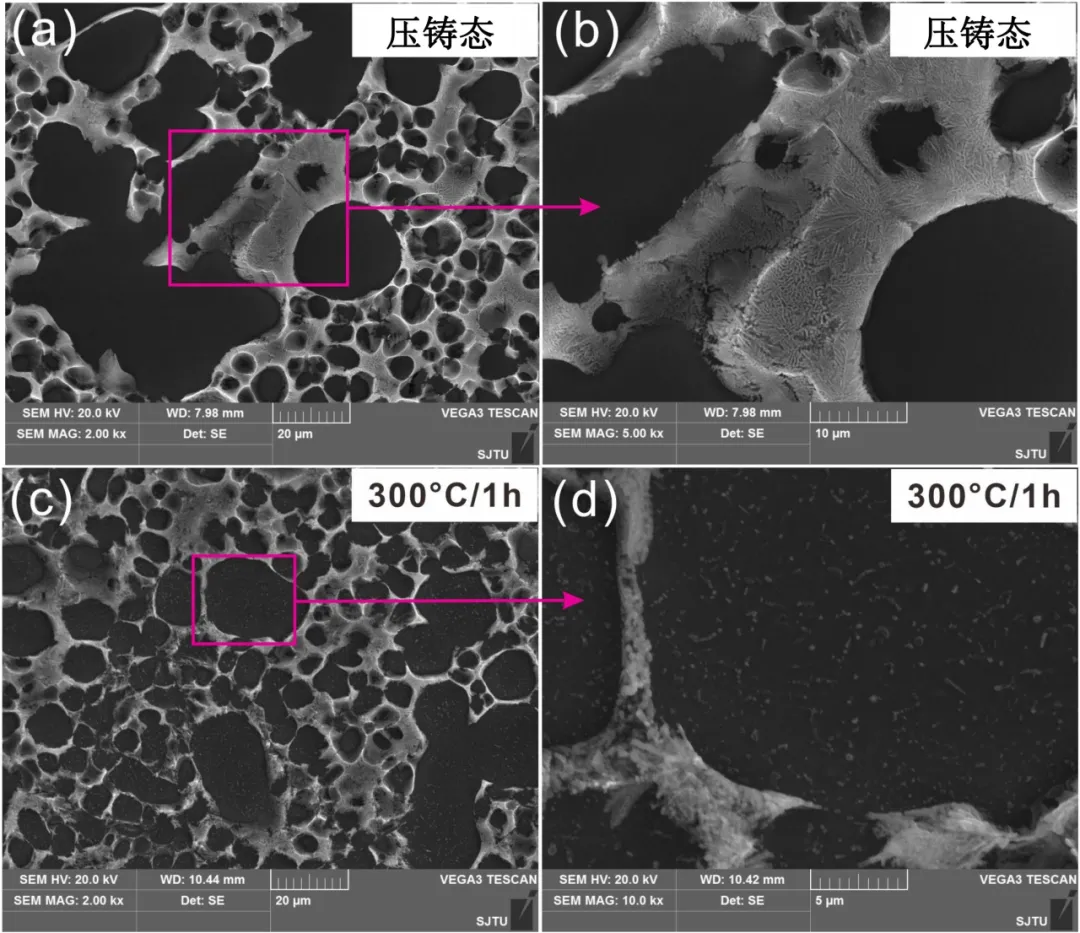
Figure 6 is a SEM secondary electron morphology photo after deep corrosion treatment. It can be seen that the eutectic Si presents a dendritic metamorphic morphology, and the eutectic divides the aluminum matrix into islands. No obvious precipitation phase was found in the aluminum matrix in the cast state. As can be seen from Figure 6c, compared with the cast state, some eutectic network chains are partially disconnected, and the island-like primary α-Al becomes gradually continuous. At the same time, granular and short rod-shaped precipitation phases were precipitated in the primary α-Al, as shown in Figure 6d. To further explore the type of precipitation phase, the solute element distribution of the precipitation phase was analyzed using EDS element surface scanning, as shown in Figure 7. It can be seen that there are mainly two types of precipitation phases, one is rich in Si, and the other is rich in Fe, Mn, and Si. The size of the precipitation phase is between tens and hundreds of nanometers, showing a dispersed distribution. Combined with the XRD spectrum (see Figure 5), no extra diffraction peaks appeared after aging, and the organizational composition was still α-Al, Si and β-AlFeSi phases, indicating that no new phases were generated after aging.
(a) As-cast (b) As-cast, local magnification
(a) As-cast (b) As-cast, local magnification
(c) Aged (300℃×1h) (d) Aged, local magnification (300℃×1h)
Figure 6 SEM microstructure of die-cast and aged alloy samples
(a) SEM, low magnification (b) SEM, high magnification (c) Al surface scan
(a) SEM, low magnification (b) SEM, high magnification (c) Al surface scan
(d) Si surface scan (e) Fe surface scan (f) Mn surface scan
Figure 7 EDS element surface distribution of precipitated phase
(a) TEM bright field image (b) Al element surface distribution
(a) TEM bright field image (b) Al element surface distribution
(d) Si surface distribution (d) Fe surface distribution
Figure 8 TEM microstructure of 300℃×1h aged alloy sample
Figure 9 Calculated equilibrium solid solubility of Fe and Si elements
Figure 9 Calculated equilibrium solid solubility of Fe and Si elements
Relationship with temperature
Figure 10 Mechanical properties of as-cast and heat-treated alloys. It can be seen that the tensile strength, yield strength and elongation of the alloy in the cast state are 245MPa, 114MPa and 5.97% respectively. After aging heat treatment at 300℃×1h, the tensile strength, yield strength and elongation of the material are 198.8 MPa, 96.6 MPa and 6.96% respectively. Compared with the die-cast state, the tensile strength and yield strength have decreased significantly, and the elongation has increased slightly. After aging treatment at 300℃×2h, the mechanical properties such as tensile strength and yield strength remain basically unchanged, and the elongation decreases. Figure 11 shows a disc heat dissipation shell product prepared by die casting. Since the difference in wall thickness will lead to differences in cooling rate, which will also affect the microstructure and conductivity, the conductivity at different wall thicknesses was measured. It can be seen that the conductivity of the die-cast state is between 23.5~24.2MS/m, and after aging treatment at 300℃×1h, the conductivity rises to 25.5~26.5MS/m. However, after aging treatment at 300℃×2h, the conductivity showed a slight decrease compared with the state after aging treatment for 1h. Combined with the mechanical properties data, it can be seen that the reasonable heat treatment process should be aging at 300℃×1h. Prolonging the aging time will not only not improve the conductivity, but also worsen the strength-conductivity matching.
(a) Engineering stress-engineering strain curve (b) Mechanical properties
(a) Engineering stress-engineering strain curve (b) Mechanical properties
Figure 10 Engineering stress-engineering strain curve and mechanical properties of die-cast alloy in cast and aging state
Figure 11 Die-cast products and conductivity in different states
Conclusion
(1) Through thermodynamic calculation, the effect of different Fe contents on the microstructure, phase composition and solid solubility of Fe and Si elements of Al-7.5Si alloy was obtained. It was found that with the increase of Fe content, the molar fraction of primary α-Al decreased, and the solid solubility of Fe and Si was the smallest when the Fe addition was 0.8%.
(2) The tensile strength of the die-cast Al-7.5Si-0.8Fe alloy is 245MPa, the elongation is 5.97%, and the conductivity is between 23.5 and 24.2MS/m; after aging at 300℃×1h, the tensile strength is 198MPa, and the conductivity is between 25.5 and 26.5MS/m. Aging treatment can significantly improve the conductivity of the alloy.
(3) The morphology of the eutectic Si phase and the solid solubility of Fe and Si are the two main microstructural factors affecting the conductivity. Among them, the spheroidization of the eutectic Si during the aging treatment enhances the continuity of the aluminum matrix and increases the mean free path of the conduction electrons, which is the main reason for the improvement of the aging conductivity.
Why is the roughness 0.8, 1.6, 3.2, 6.3, 12.5?
How To Design The Die Casting Mold To Help Extend The Life Of The Mold
Related Article

Fast sampling is the fastest way to win business in the hardware machining and plastic mold industries. Customers want a working sample in days, and a 3D printer delivers it, but only when you know how to print in 3d correctly.
how to print in 3d

Fast sampling is the fastest way to win business in the hardware machining and plastic mold industries. Customers often send an STL file and expect a working sample in days.
how to print an stl file

