
Four questions about mold hot runners
Author: SZTC
2024-11-21
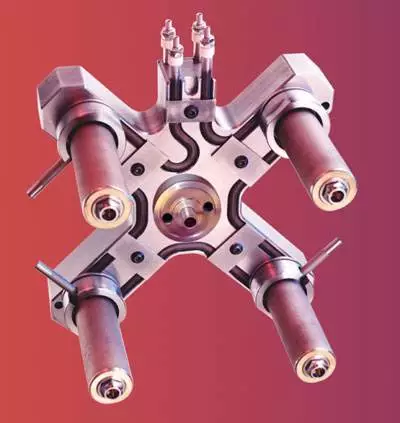
1. What is a hot runner?
Hot runner technology is an advanced technology applied to the pouring runner system of plastic injection molds, and is a hot direction in the development of plastic injection molding technology. The so-called hot runner molding means that the plastic sent from the injection machine nozzle to the gate is always kept in a molten state, and does not need to be solidified and taken out as waste every time the mold is opened. The molten material retained in the pouring system can be injected into the cavity during the next injection.
An ideal injection molding system should form parts with consistent density, which are not affected by all runners, flash and gates. Compared with cold runners, hot runners must maintain the molten state of the material in the hot runner to achieve this, and will not be sent out with the molded parts. The hot runner process is sometimes called a hot manifold system, or runnerless molding. Basically, the hot manifold can be regarded as an extension of the barrel and the nozzle of the injection molding machine. The function of the hot runner system is to deliver the material to each gate in the mold.
2. Advantages and disadvantages of hot runner technology?
What benefits can hot runner technology bring us? Friends who are familiar with the injection molding process know that conventional injection molding often has the following unfavorable factors:
1. Difficulty in filling the mold.
2. Deformation of thin-walled large parts.
3. Waste of runner raw materials.
4. The quality of injection molded parts of multi-cavity molds is inconsistent. The emergence of hot runner technology provides a relatively complete solution to these problems. Generally speaking, the use of hot runners has the following benefits:
1 Save raw materials and reduce costs.
2 Shorten the molding cycle and improve machine efficiency.
3 Improve the surface quality and mechanical properties of the product.
4 Point gates can be used without using three-plate molds.
5 Single products can be economically molded with side gates.
6 Improve the degree of automation.
7 The gate freezing can be controlled by needle valve gates.
8 The quality of injection molded parts of multi-cavity molds is consistent.
9 Improve the surface aesthetics of injection molded products.
However, every technology has its own shortcomings, and hot runner technology is no exception:
1 The mold structure is complex, the cost is high, and the maintenance cost is high.
2 It takes a while for the process to stabilize after starting the machine, resulting in a large number of waste products.
3 When melt leakage occurs and the heating element fails, it has a great impact on product quality and production progress.
The third shortcoming above needs special attention. By purchasing high-quality heating elements, hot runner plates and nozzles and carefully maintaining them during use, the occurrence of these adverse situations can be reduced.
3. What are the components of the hot runner system?
The hot runner is composed of four parts: hot runner plate, nozzle, heating element, and thermostat.
4. Which molds are suitable for using hot runners
The above has talked about so many benefits of hot runners, so can every mold use hot runners? The answer is no. Generally speaking, hot runner technology is only applicable to plastic molds, and not every plastic mold is suitable.
How to evaluate whether the ejector stop block needs to be replaced?
HOW ARE PLASTIC BOTTLE CAPS INJECTION MOLDED AND DESIGNED? NO WONDER BEAUTIES CAN'T OPEN THEM!
Related Article

Fast sampling is the fastest way to win business in the hardware machining and plastic mold industries. Customers want a working sample in days, and a 3D printer delivers it, but only when you know how to print in 3d correctly.
how to print in 3d

Fast sampling is the fastest way to win business in the hardware machining and plastic mold industries. Customers often send an STL file and expect a working sample in days.
how to print an stl file

