
Light And Safe, Thermoforming Technology Tells You What Is The Black Technology Of One-piece Car Body?
With the continuous improvement of users' requirements for vehicle safety, the safety of automobiles is rapidly improving and improving, and it has also become the first consideration factor for users when choosing a model. In addition to active safety, which can prevent accidents before they occur, car companies have paid more and more attention to the development of passive safety of the vehicle itself. As the last line of defense to protect passengers, the related technologies of the body are also constantly improving. At the same time, reducing the body weight in order to achieve the goal of energy saving and emission reduction has also become the direction of efforts between mainstream OEMs and suppliers. In order to adapt to this development trend, major related companies have developed high-strength steels for body parts, and at the same time, the problem of forming high-strength steels at room temperature is difficult. As a result, thermoforming technology came into being.
It is true that the hot forming technology was mainly developed for high-strength steel plates in the early stage. The process is as follows: first, the boron alloy steel plate with a strength of 500-600 MPa at room temperature is heated to 850-950 ° C to make it uniformly austenitized, and then sent into the interior. It is stamped and formed in a mold with a cooling system, and finally rapidly cooled to convert austenite into martensite, so that the stamped parts are hardened and the strength is greatly improved to achieve the purpose of facility safety. It is precisely because the use of high-strength steel makes the car body stronger and safer. At the same time, compared with other materials, hot-formed steel has a higher cost performance. Therefore, its use has been continuously improved in recent years, and hot-forming technology has gradually developed into an application. The black technology in the body.
However, for the design and developers of the car body, it is still necessary to continuously realize the lightweight of the body while ensuring the safety performance. Therefore, with the improvement of design capabilities and the improvement of functional requirements, it is suitable for various positions of the body in recent years to meet the functions of various parts. New hot forming processes, new materials, and new designs that are in demand also follow the trend. Gasgoo took stock of five current mainstream stamping and hot forming technologies that combine new processes and new materials.
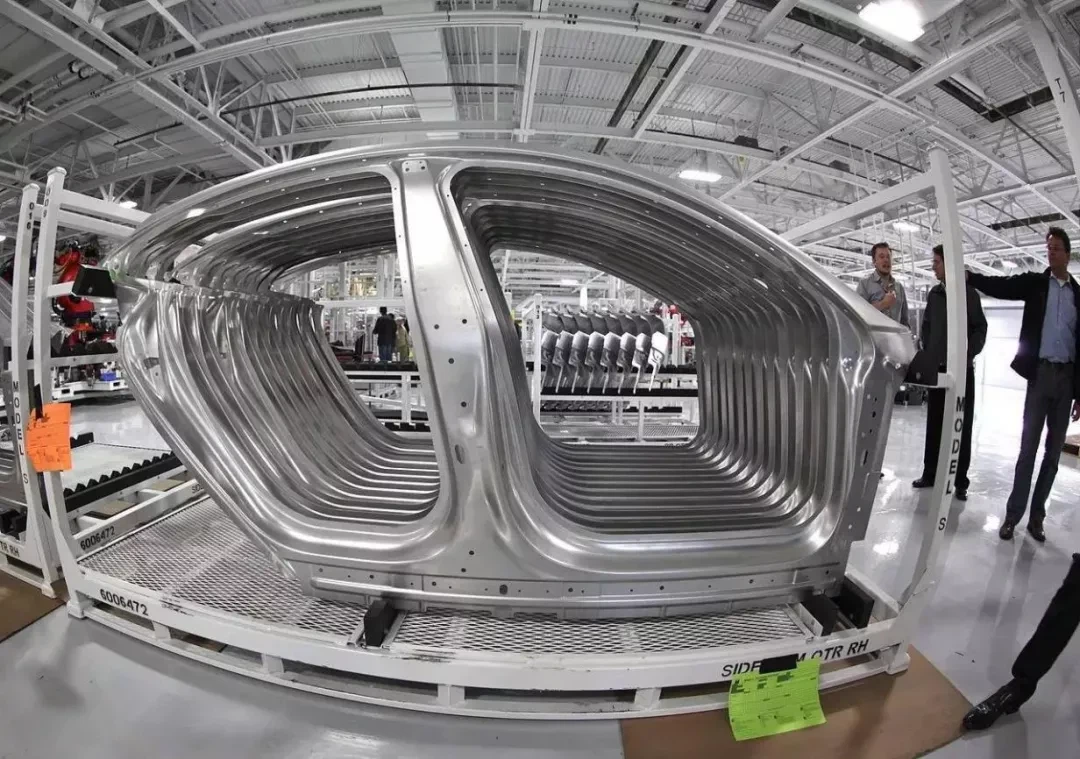
One-piece body stamping, image credit: Tesla
Short-flow hot-rolled hot-formed steel
From the perspective of sustainable development, the low-carbonization of the automobile industry can no longer rely solely on energy conservation and emission reduction during vehicle service, but also requires low-carbonization of all processes in the entire life cycle from design, manufacturing, use to recycling. The short-flow rolling technology with the advantages of low energy consumption has gradually entered the field of vision of automotive product engineers. Compared with the conventional hot rolling process, the energy consumption of the thin slab continuous casting and rolling process is reduced by more than 50%. The process characteristics of thin slab continuous casting and rolling, rapid solidification and direct rolling, are especially suitable for the development of thin-gauge hot-rolled high-strength steel products.
It is understood that domestic mainstream steel mills have developed CSP (compact strip production) short-flow hot-formed steel, the performance is almost the same as the existing hot-formed steel, and the application parts can also be consistent with the existing hot-formed steel. A major feature of this type of material is that it reduces the energy consumption in the production of raw materials, which is the direction of sustainable development in the future. Lingyun Co., Ltd. has obtained FAW Audi Q5, FAW-Volkswagen CC, X55 thermoforming projects through thermoforming technology; has realized the supply of unequal thick plate thermoformed products in Volkswagen models; obtained 14 types of 20 thermoformed products from BYD.
Variable Section Thermoforming Technology
The variable cross-section thermoforming technology refers to the use of a sheet of sheet material with varying cross-sectional thickness for hot stamping. The hot stamping forming process is no different from traditional hot forming. This kind of plate with changing section thickness can design the thickness transition of the plate and strip according to the characteristics of the force change of the parts, and realize the structural weight reduction on the premise of ensuring the performance through customized products. In 2006, the Dodge Calibre and BMW X5 were the first cars to feature custom rolled and stamped hardened components in the body.
Segmental strengthening hot forming technology
Gestamp, a well-known European body supplier, has the deepest research on this technology, and the company has recently obtained related patents. On the basis of traditional multi-station stamping, Gestamp merges dies of different steps into one station, which can continuously complete this hot forming technology, which also means that it is a revolutionary technology in die rolling mill. R&D. Because of the problem of material strength, it is necessary to ensure that it can achieve the hot stamping technology on the basis of the traditional cold stamping process and efficiency, so Gestamp combines the continuous stamping and hot stamping technologies of cold stamping together. In addition, in terms of materials, the current application is the synthetic application of a variety of materials. For example, there are aluminum applications and carbon fiber applications, which not only meet the traditional safety requirements, but also meet the needs of lightweight. In hot stamping technology, Gestamp has been innovating the technology of one-piece door knockers for many years.
It is worth mentioning that Gestamp has already established a presence in China. Its joint venture with Hainachuan, a well-known auto parts supplier in China, was put into operation in 2018. The investment in the new factory exceeded 50 million euros (390 million RMB). ), with more than 250 employees, dedicated to the stamping and assembly of automotive body-in-white and chassis components.
Gestamp Smart Workshop, Image source: Gestamp
Laser Tailored Thermoforming Technology
In 2019, the hot stamping laser welding internal and external front door ring system was applied for the first time on the Acura RDX model, and the laser tailor welding hot forming technology was deeply imprinted in the minds of domestic automotive material engineers. In fact, as early as 2014, the Acura MDX model showed the world a laser-welded outer door knocker.
Laser tailored welding thermoforming technology refers to the technology of using laser energy to assemble and weld plates of different materials, plate thicknesses and coatings to form a whole plate and then hot stamping as a whole before the hot stamping process. The emergence of tailor-welded blank technology solves the problem of ultra-wide plates and different process performance requirements for different parts, and plays an important role in reducing body weight, reducing vehicle costs, energy saving and environmental protection. At present, the main suppliers of laser tailor welded hot forming steel are: ArcelorMittal, ThyssenKrupp Steel, Nippon Steel, Baosteel Co., Ltd.
High-strength aluminum alloy hot forming technology
Although it is difficult to shake the status of steel as the main material of automobile body in a short period of time in view of the strength requirements of the body, the price of lightweight materials and the level of processing technology, but the body is an area with great potential for lightweighting, and the use of aluminum alloy can reduce the weight by about 40%. %, there are still many companies that continue to break the boundaries in the field of high-strength aluminum alloy hot forming.
High-strength aluminum alloy hot forming + quenching technology (HFQ patent), a revolutionary aluminum alloy hot forming technology, was developed by Impression Technology, a British company, introduced into China through Changchun Jiwen, and established a large-scale mass production production line in China. This technology is low-cost, high-efficiency, low-investment, high-performance aluminum alloy hot stamping and lightweight manufacturing technology. It achieves light weight and weight reduction through the integration of stamping parts and the use of high-strength aluminum alloys to reduce the thickness of parts. In view of the reduction in the number of molds and parts designed and manufactured, the total investment cost is reduced. This technology can reduce the weight of parts by 20%-40%. At the same time, the formed stamping parts have no springback. The design of stamping parts and molds does not require consideration of springback compensation, which greatly shortens the development cycle and enhances the repeatability of high-level product dimensional accuracy. and controllability, greatly improving the design flexibility of the engineering team.
High-strength aluminum alloy body, photo credit: Ford
New technology and new materials create a new market for thermoforming
China's automobile production continues to rise, the requirements for light weight, energy saving and emission reduction and increasingly strict automobile safety regulations have provided a broad market opportunity for hot stamping steel. Compared with lightweight materials such as magnesium-aluminum alloy and carbon fiber, hot-formed steel has relatively low life cycle emissions, so that it not only reduces emissions in the manufacturing stage, but also maintains a relatively competitive emission reduction capacity in the automotive use stage. Conducive to the realization of energy-saving goals in the entire life cycle of automobiles. The development of intelligent vehicles can reduce traditional active and passive collision problems such as traffic accidents to a certain extent, but new hidden dangers of network information security will appear in the field of intelligent vehicles. Therefore, once a safety accident occurs, passengers may suffer more fatal injuries. harm.
Therefore, passive structural safety will still be the most basic design requirement for automobiles, and high-strength automotive steel is still needed to increase safety performance. Many domestic and foreign companies have demonstrated their innovative solutions in thermoforming, and each unit from design to production has its own unique application ideas.
Material And Structure Affect Performance - 3D Printing Technology Application Of Winter Olympic Snowmobile Helmet
Electroplating Process Of Plastic Products (water Electroplating And Vacuum Electroplating) There Are Two Common Electroplating Processes For Plastic Products: Water Electroplating And Vacuum Ion Plating.
Related Article



