Analysis Of Manufacturing Process Of Automobile Steering Wheel Made Of Die-cast Magnesium Alloy
I. Historical background
With the rapid development of the automobile industry, cars are getting faster and faster, their appearances are getting more and more beautiful, their interior decorations are becoming more and more complex and diverse, and their inherent technological content is getting higher and higher. The steering wheel has also undergone considerable changes. Magnesium alloy is the lightest metal structural material. It has the advantages of high specific strength, superior damping, shock absorption and noise reduction performance, good casting moulding, machining and surface decoration performance, and easy recycling. Magnesium alloy used in the steering wheel can achieve lightweight and reduce the vibration of the road surface and control system. At the same time, when an accident occurs, the magnesium alloy steering wheel can absorb more energy to ensure the safety of the driver. Therefore, it has traditional steering wheels such as low carbon steel and engineering plastics. Unmatched performance advantage. Therefore, it will be an inevitable trend to use magnesium alloys to replace other traditional materials such as steel and aluminium alloys to manufacture automobile steering wheel skeletons.
II. Technical solution
1. Selection of alloy materials
With aluminium as the main alloying element, as the aluminium content decreases, the toughness of the alloy gradually increases. Therefore, low-aluminium AM series magnesium alloys are more suitable for safety components such as steering wheels. However, as the aluminium content decreases, the castability of the alloy is reduced to a certain extent. Therefore, when selecting an alloy that can achieve the required mechanical properties, a higher aluminium content should be ensured to ensure its castability. Therefore, choose AM60, which has high strength, good toughness and certain casting performance, is used as the material of the steering wheel. According to the data searched from the Internet, the mechanical properties of this series of magnesium alloys are good, the elastic modulus E can reach 45 GPa, the Poisson's ratio ε is 0.35, the tensile strength σb≥200MPa, the yield strength σs≥13OMPa, and the elongation. δ≥6% (50mm gauge length). In terms of weight, it is more than 30% lighter than traditional iron and aluminium alloys; the process pass rate of magnesium alloy steering wheels is equivalent to that of aluminium alloy steering wheels, reaching more than 85%; the performance fully meets the requirements of steering wheels.
2. Parts drawing
3. Model design and manufacturing process
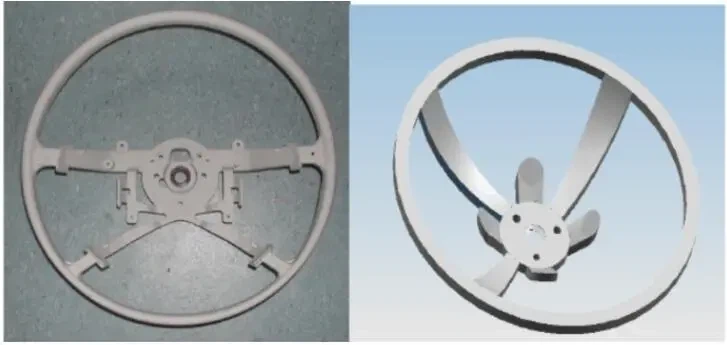
The steering wheel is mainly subjected to alternating stress caused by torsion. According to the requirements of the steering wheel mechanical performance test standard, the static torsional failure torque should be greater than 300N·m, and the steering wheel body structure should be based on the three-dimensional structure data model of the steering wheel obtained from the finite element analysis. The die-casting moulding process has the characteristics of high pressure and high-speed filling. It can die-cast castings with thin walls, complex shapes, and small holes and threads. It can also die-cast inserts. The strength and surface hardness of the die-castings are high. It is the production of magnesium Effective method for alloy parts. Aiming at the overall structure of the steering wheel, combined with the characteristics of magnesium alloy body material fatigue performance being very sensitive to inherent defects, the forming process factors of the new material structure are analyzed, and the best performance structure can be obtained while ensuring the casting The quality of the best process structure and process parameter combination meets the requirements of the components for the inherent quality and related fatigue properties of the castings and lays the production foundation for the reasonable application of new materials on the steering wheel. Given the above situation, according to the requirements of the die-casting process, a preliminary design of the steering wheel die-casting mould casting system. Magnesium alloy die-casting moulding technology mainly includes magnesium alloy melting and protection, die-casting design, process control, and subsequent heat treatment of load-bearing parts.
Numerical simulation software is used to simulate the die-casting process of the designed die-casting process plan, and further optimize the steering wheel pouring, overflow system and process parameter combination by analyzing the filling process, solidification process and casting defects in the die-casting process. The final plan provides an important reference for producing high-quality steering wheel die-casting parts. The existing ordinary cold press chamber die-casting machine can be used to produce magnesium alloy die-casting parts. When the filling temperature is 700 ℃, the die-casting temperature is 220 ℃, and the punch speed is 2.34 m/S, an ideal steering wheel skeleton can be obtained. According to the calculation process optimization results, a qualified AM60 magnesium-alloy steering wheel skeleton was trial-produced. A universal testing machine was used to test the fatigue performance and mechanical properties of the steering wheel skeleton. The results showed that its average fatigue life reached 10,000 times, the tensile strength was 220 MPa, and the elongation rate was 5%.
The trial production and performance test of the magnesium alloy steering wheel skeleton was based on the simulation results of FIow23D, using optimized process parameters, and the steering wheel was trial-produced on an 8 000 kN die-casting machine, and qualified products were obtained. The fatigue performance of the AM60 magnesium-alloy steering wheel skeleton produced was tested on the universal steering wheel tester. During the test, the centre of the steering wheel is fixed, and 250 kN of soil force is repeatedly applied in the vertical direction of the rim until the steering wheel breaks. The measured number of cycles is the fatigue life of the steering wheel skeleton. The fatigue life of the steering wheel skeleton produced is an average of 110,000 times, and the fracture position is shown in Figure 4, and the enterprise standard is 100,000 times, indicating that the fatigue performance of the steering wheel skeleton has reached the enterprise's requirements.
It can be seen from Figure 5 that the fatigue cracks are generated on the outside of the rim. This is because the steering wheel skeleton is solidified during the solidification process. Because there are more slag bags placed on the outside of the rim, it solidifies last relative to the inside of the rim. Therefore, there are relatively many defects, which is a possible reason for the fatigue cracks originating on the outside of the rim. The fracture position of the rim is the position where the alternating tensile and compressive stresses are the largest during the loading process. Figure 5b shows the fatigue crack growth zone, which has typical characteristics of fatigue cracks. See the fatigue transient zone. Figure 5c shows the characteristics of transgranular fracture. Figure 5d is a photo of the loose structure in the fracture area. It can be seen from Figure 5d that there is a loose structure on the fatigue fracture, which is caused by pressure fluctuations during the die-casting process. The mechanical properties of the steering wheel skeleton were tested. The tensile strength was 220 MPa and the elongation was 5%. Although the sampling positions are different, the test results show that the mechanical properties are not much different, which shows that the die-casting structure of the steering wheel skeleton is more uniform after the calculation process is optimized.
III. Market forecast and price analysis
According to foreign forecasts, airbags will be installed in automobiles in the future. Because magnesium alloy steering wheels are light, shock-absorbing and safe. After the car is equipped with airbags, almost all cars must be 100% replaced with magnesium alloy steering wheels. Due to the increase in the demand for private cars and the development of the western region, the average growth rate of the total demand for automobiles in the next few years will be about 10%. The use of magnesium alloys to replace other traditional materials such as steel and aluminium alloys to manufacture automobile steering wheel frames and build magnesium alloys Die-casting automobile steering wheel production line. The use of one-piece die-casting technology can reduce production costs.
Why Is Titanium Alloy A Difficult Material To The Machine?
Differential Pressure Casting Of Large Complex Magnesium Alloy Shell Castings
Related Article